
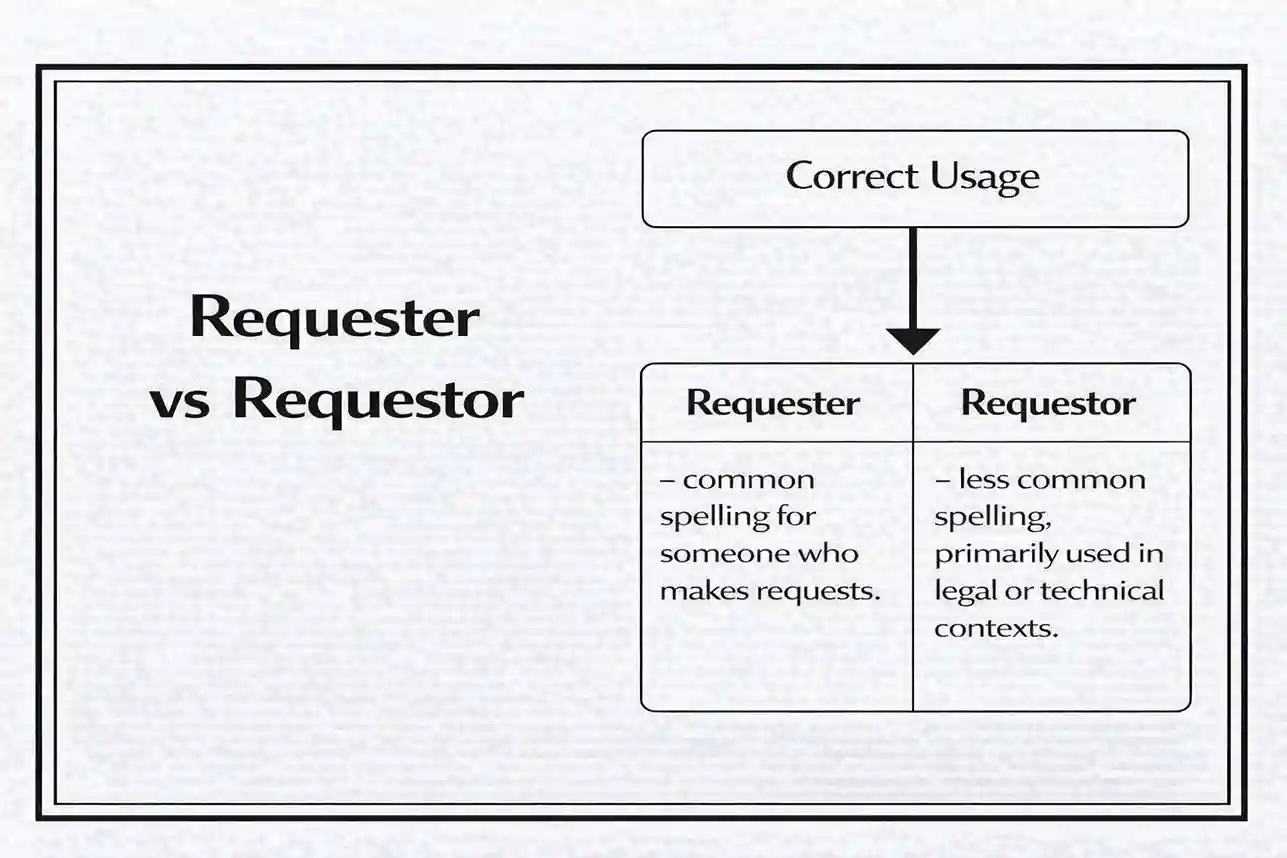
If you searched “Requester vs Requestor”, you’re probably dealing with one of these:
- You’re writing an email, contract, or policy and don’t know which spelling looks right
- You saw both “requester” and “requestor” in different places and got confused
- You want to use the correct, professional word so nobody laughs at your spelling
- You need a clear rule you can follow every time
Let’s keep this simple, clear, and practical.
Short answer
- ✅ Both “requester” and “requestor” are real words.
- ⭐ “Requester” is the more common and safer spelling in modern English.
- ✅ “Requestor” is also correct, but it’s less common and mostly used in legal, corporate, or technical documents.
- 📌 In most cases, if you’re not sure, choose “requester.”
The rest of this guide explains Requester vs Requestor in easy language, with examples, tables, and situations.
What Does “Requester” Mean?
Requester is a noun.
It means the person or group who asks for something.
In simple words:
Requester = the one who makes a request.
This “something” can be:
- information
- money
- access
- documents
- service
- approval
Easy examples with “requester”
- The requester asked for a refund.
- The requester filled out the form online.
- The report will be sent to the requester by email.
- The requester must show ID before we release the file.
Here, requester is just like:
- buyer
- sender
- reader
- user
All of these words end with -er and show who does the action.
What Does “Requestor” Mean?
Now the important part of Requester vs Requestor:
Requestor means the same thing as requester.
Requestor = another spelling of requester.
It also means:
the person, group, or company making a request.
So why do we even have two spellings?
Because different fields and organizations choose different spellings.
Some legal teams, companies, or software systems prefer “requestor” and use it everywhere for consistency.
Easy examples with “requestor”
- The requestor submitted a purchase order.
- The requestor will be notified once the payment is approved.
- If the requestor cancels the request, the process will stop.
Meaning is the same as requester.
Only the spelling and style change.
Requester vs Requestor – Quick Comparison Table
Here is a quick Requester vs Requestor table you can scan fast:
| Point | Requester | Requestor |
|---|---|---|
| Type of word | Noun | Noun |
| Basic meaning | Person/party making a request | Same meaning as requester |
| Commonness | More common overall | Less common |
| Feel / tone | Neutral, modern, general | Slightly more formal or “corporate” |
| Typical usage | Emails, guides, general business writing | Contracts, policies, forms, IT systems |
| US / UK English | Favored in both | Seen, but not as often |
| Safe default choice | ✅ Yes, very safe | ⚠ Use if your template/company already uses it |
| Example sentence | The requester must sign the form. | The requestor must sign the form. |
So for most people, most of the time, “requester” is the better choice.
Is One More “Correct”? (Requester vs Requestor)
Many people think one of them must be wrong.
Good news:
In Requester vs Requestor, both spellings are correct English.
The difference is:
- Requester → more common, more standard, used in everyday and business English
- Requestor → also correct, but used more in specific areas like law, finance, corporate systems, and some government documents
If you want your writing to look:
- modern
- clean
- easy for everyone to understand
…then “requester” is your best friend.
If you are following a template or a contract that already uses “Requestor” as a defined role, then you must stay with “Requestor” in that document.
Requester vs Requestor in Real Situations
Now let’s look at where each spelling is usually used in real life.
Everyday writing (emails, help docs, blogs)
If you are writing:
- an email to a client or boss
- a help article or FAQ
- instructions for staff
- general documents for normal readers
…then “requester” is almost always the better choice.
Examples:
- The requester can track the status online.
- We will contact the requester if we need more information.
- Each requester must provide a valid email address.
Here, requestor would look a bit strange or heavy to many readers.
Legal documents and contracts
In legal writing, consistency is very important.
Some law firms and legal departments use “Requester”, some use “Requestor”. Both are correct, but once they choose one, they stick to it.
You may see something like:
“Requester means the party that submits a formal request under this Agreement.”
or
“Requestor means the person or entity submitting a Request for Services.”
After that definition, the document will keep using exactly that spelling.
So in legal Requester vs Requestor usage:
- Follow the defined term in the contract
- Do not change spelling halfway
If the definitions section says “Requestor”, then write “Requestor” every time in that contract.
Business, finance, and procurement
In many companies, especially in:
- purchasing and procurement
- expense approvals
- invoice processing
- form-based workflows
you will see roles like:
- Requester
- Requestor
- Approver
- Reviewer
One company might name the role “Requester”, another might name it “Requestor.”
Examples:
- The Requestor submits the purchase request.
- The Approver reviews the request and either approves or rejects it.
- Both the Requester and the Approver will receive a confirmation email.
In this case, follow whatever your company already uses in:
- forms
- portals
- internal guides
If you are starting from zero and choosing a spelling for a new system, “Requester” matches better with words like:
- buyer
- owner
- sender
- reviewer
All of them end in -er, not -or.
IT, software, and APIs
In software, we often see role names and field names like:
requester_idrequester_emailrequestor_idrequestor_name
There is no grammar rule here. It’s just a naming choice by the developer or team.
If your system already uses “requestor” in code or the UI, it is better to keep it consistent instead of mixing.
If you are designing new names, most people find “requester” looks more natural and cleaner, because of those common -er endings.
Grammar: How to Use “Requester” and “Requestor”
Both requester and requestor work the same in grammar, because they are both nouns.
Singular and plural
- Singular: requester / requestor
- Plural: requesters / requestors
Examples:
- The requester filled in the form.
- The two requesters asked for a time extension.
- Each requestor will receive a tracking number.
- The requestors were informed of the decision.
With “the”, “a”, and “an”
You can use them with articles like any normal noun:
- The requester must sign here.
- A requestor may cancel the request before approval.
- If the requester disagrees, they can appeal.
Possessive form (’s)
- The requester’s email address is invalid.
- We updated the requestor’s phone number.
Here again, Requester vs Requestor makes no difference in grammar. Only spelling changes.
More Example Sentences (Requester vs Requestor)
Sometimes the easiest way to feel the difference is to see them in full sentences.
Sentences with “requester”
- The requester must attach all supporting documents.
- We will reply to the requester within three business days.
- If the requester does not respond, the case will be closed.
- The system sends a confirmation email to the requester after submission.
- Each requester receives a unique reference number.
Sentences with “requestor”
- The requestor is responsible for the accuracy of the information provided.
- Once the requestor uploads the files, the review process begins.
- The requestor and the Approver cannot be the same person.
- The system will notify the requestor about the final decision.
- Every requestor should keep a copy of their submitted request.
Again, Requester vs Requestor here is only a matter of spelling choice, not meaning.
Common Mistakes with Requester vs Requestor
Mistake 1: Mixing both spellings in one document
This looks messy and unprofessional.
❌ The requester must sign the form. If the requestor does not sign, the request will be delayed.
Better:
✅ The requester must sign the form. If the requester does not sign, the request will be delayed.
or
✅ The Requestor must sign the form. If the Requestor does not sign, the request will be delayed.
🔑 Rule: In one document, pick one spelling and use it every time.
Mistake 2: Thinking “requestor” is wrong or fake
Some people think requestor is just bad English. It isn’t.
- Requester → more common spelling
- Requestor → less common, but still correct, especially in formal or technical contexts
If you see requestor in a contract, policy, or form, it doesn’t mean the writer is wrong. It just means they follow a different style.
Mistake 3: Confusing the noun and verb
Remember:
- request → verb (action)
- requester / requestor → noun (person)
So:
- She will request more time. ✅ (verb)
- She is the requester of more time. ✅ (noun)
Don’t write:
- She will requester more time. ❌
- He requestored a refund. ❌
These do not exist.
How to Choose Quickly (Simple Decision Guide)
Here is a simple Requester vs Requestor decision guide you can keep in mind:
Use “Requester” when:
- You’re writing for normal readers
- You’re writing emails, guides, blog posts, help center articles
- Your company does not have a strict rule about the spelling
- You want the safer and more common word
✅ In most situations, “requester” is the best choice.
Use “Requestor” when:
- A contract, policy, or template already defines a role as “Requestor”
- Your internal system, app, or software uses “Requestor” as a fixed label
- Your legal or compliance team prefers “Requestor” and uses it everywhere
In those cases, follow their spelling, because consistency matters more than which version you personally like.
Frequently Asked Questions (FAQs)
Yes. Requestor is correct.
It is a less common spelling, but it is still proper English and is often used in:
contracts
policies
corporate forms
government or finance documents
It means the same as requester.
In everyday and general business English, “requester” is more common and feels more natural to most readers.
So, in a Requester vs Requestor choice for normal use, requester wins.
No.
There is no meaning difference between requester and requestor.
Both mean:
the person, group, or organization who makes a request.
Only the spelling and typical context change.
If you are not following a set template or legal wording, use:
“Requester”
Example:
As the requester, you will receive all status updates by email.
This looks clear, professional, and standard.
You can choose different spellings for different documents, but:
In the same document, don’t mix them.
For example:
In contracts for one client, you may always use “Requestor” because that contract started with that spelling.
In blog posts and guides, you may always use “requester.”
But inside one article or one contract, pick one spelling and stay loyal to it.
Many readers feel that “requester” looks more modern and natural, because they are used to seeing other -er words:
buyer
seller
reader
writer
owner
So yes, in the Requester vs Requestor battle for a simple modern style, “requester” usually feels more up to date.
Easy Memory Trick
To remember which one to choose, use this quick trick:
Think of common words that show who does something:
- buy → buyer
- write → writer
- own → owner
- send → sender
All of them end with -er, not -or.
So when you think about RequestER vs RequestOR:
The -er ending matches most everyday English words.
That’s why “requester” is the safe, simple default.
If you don’t have a rule forcing “requestor,” go with “requester.”
Final Summary – Requester vs Requestor
Let’s close the Requester vs Requestor debate in one place:
- ✅ Both words are correct.
- ✅ Both mean the same thing: the person or party who makes a request.
- ⭐ “Requester” is more common, easier for most readers, and a very safe choice in general writing.
- ✅ “Requestor” is also correct, but usually appears in legal, corporate, or technical contexts where that spelling is already chosen.
- 📌 The most important rule: Choose one spelling per document and use it consistently.
If you’re ever unsure and just want to be safe:
👉 Write “requester.”

About Grayson
Grayson is a professional English language teacher and the founder of WordEncyclo. With years of teaching experience, he specializes in vocabulary development, etymology, and word usage. His mission is to make English words and their meanings accessible to learners at all levels through clear, accurate, and well-researched content.