
If you searched lo siento in English, here’s the direct meaning:
Lo siento in English = “I’m sorry.”
That’s the correct translation in most cases.
But to use the phrase naturally (and translate it properly), you also need to know when Spanish uses lo siento, when Spanish uses perdón, and when English speakers would say excuse me instead of I’m sorry.
This guide explains lo siento in English with easy language, real examples, and clear tables. By the end, you will know exactly what to say in real conversations and how to translate it correctly.
Lo Siento in English (Quick Meaning)
✅ Lo siento = I’m sorry
✅ Used for apology, regret, and sympathy
❗ Not the best choice for small “excuse me” moments (you’ll usually use perdón or disculpa)
Quick definition box
Lo siento in English: I’m sorry.
Used for: apologies + sympathy + regret.
Literal idea: I feel it (I feel bad about it).
What Does “Lo Siento” Mean in English?
The most common meaning is:
- Lo siento → I’m sorry
But in real life, lo siento can match different English sentences depending on context:
- “I’m sorry.” (apology)
- “I’m sorry to hear that.” (sympathy)
- “Sorry, I can’t.” (polite refusal)
- “I feel bad about that.” (regret)
So when translating lo siento in English, you should translate the message, not only the words.
Literal Meaning of Lo Siento (Word-by-Word)
This helps you understand why it’s emotional.
| Part | Spanish | Literal Meaning | Simple meaning |
| Object | lo | it / that | “about that thing” |
| Verb | siento | I feel | I feel (emotion) |
So lo siento literally means:
“I feel it.”
That’s why it often means:
“I feel bad about it.” / “I’m sorry.”
How Spanish Uses “Sorry” Differently Than English
English uses different phrases depending on the situation:
- Excuse me → to get attention, pass someone, interrupt politely
- Sorry → for small mistakes (bumping someone, stepping on foot)
- I’m sorry → for real apology or sympathy
- My condolences → for death/loss (more formal)
Spanish sometimes uses one phrase (lo siento) for deeper emotions, and perdón/disculpa for small interruptions.
This is the key to understanding lo siento in English correctly.
1) When to Use Lo Siento (With Correct English Translations)
A) Lo Siento = “I’m sorry” (You did something wrong)
Use lo siento when you made a mistake or caused a problem.
Examples (Spanish → English)
- Lo siento, llegué tarde.
→ I’m sorry, I’m late. - Lo siento por el error.
→ I’m sorry for the mistake. - Lo siento, fue mi culpa.
→ I’m sorry, it was my fault. - Lo siento, no te escuché.
→ I’m sorry, I didn’t hear you. - Lo siento, olvidé tu mensaje.
→ I’m sorry, I forgot your message.
✅ These are direct matches for lo siento in English = I’m sorry.
B) Lo Siento = “I’m sorry” (Sympathy / empathy)
Use lo siento when something bad happened to someone and you want to show empathy.
Examples
- Lo siento por tu pérdida.
→ I’m sorry for your loss. - Lo siento mucho, qué triste.
→ I’m very sorry, how sad. - Lo siento, eso debe ser difícil.
→ I’m sorry, that must be difficult. - Lo siento que estés pasando por eso.
→ I’m sorry you’re going through that.
In English, people often add “to hear that,” but Spanish often doesn’t.
C) Lo Siento = “Sorry, I can’t” (Polite refusal)
Use lo siento to say “no” politely.
Examples
- Lo siento, no puedo ir hoy.
→ I’m sorry, I can’t go today. - Lo siento, pero no tengo tiempo.
→ Sorry, but I don’t have time. - Lo siento, pero no.
→ I’m sorry, but no.
This is a very common usage in real conversation.
2) Stronger and Softer Versions of Lo Siento
Spanish speakers change intensity using words like mucho and tanto.
| Spanish phrase | Lo siento in English | Strength | Best for |
| Lo siento | I’m sorry | Medium | normal apology/sympathy |
| Lo siento mucho | I’m very / really sorry | Strong | serious apology, bad news |
| Lo siento tanto | I’m so sorry | Very strong | emotional situations |
| Lo siento por… | I’m sorry for… | Specific | when you name the reason |
| Lo siento, pero… | I’m sorry, but… | Medium | polite refusal |
Example set
- Lo siento por llegar tarde. → I’m sorry for being late.
- Lo siento mucho por llegar tarde. → I’m really sorry for being late.
- Lo siento tanto, de verdad. → I’m so sorry, truly.
3) Lo Siento vs Perdón vs Disculpa (Most Important for Natural Speech)
This is where most learners fail. They know lo siento in English, but they use lo siento in places where Spanish speakers would never use it.
Quick comparison table
| Spanish | Closest English meaning | When to use | Typical situation |
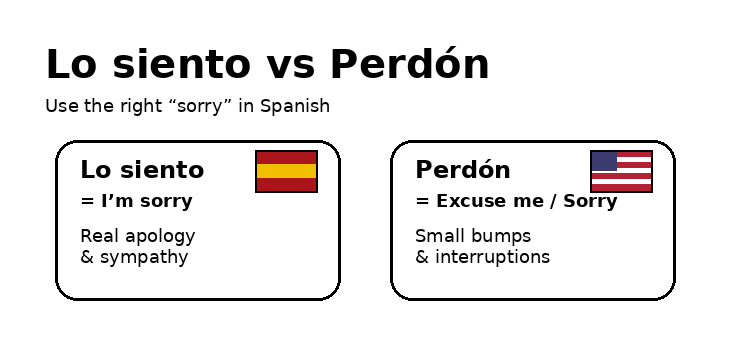
| Lo siento | I’m sorry | regret/sympathy/real apology | “I hurt you”, “bad news” |
| Perdón | sorry / excuse me | small accidents, quick interruptions | bumping into someone |
| Disculpa (informal) | excuse me / sorry | polite interruption (casual) | talking to a friend |
| Disculpe (formal) | excuse me | polite interruption (formal) | stranger, customer, boss |
Easy rule
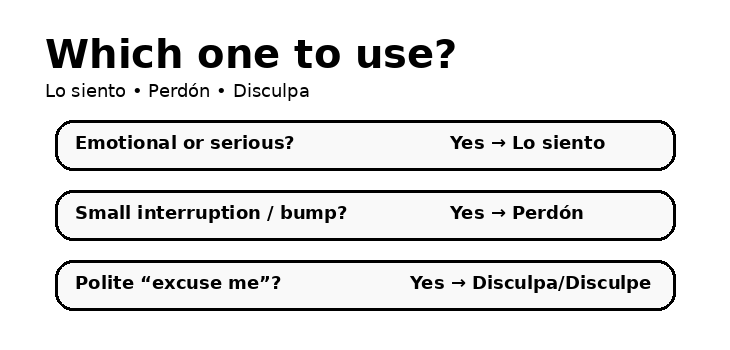
- Emotional / serious? → Lo siento
- Small / quick “excuse me”? → Perdón / Disculpa / Disculpe
4) Real Situations: What to Say (With English)Situation 1: You bump into someone
✅ Perdón
→ Sorry / excuse me
Better than lo siento because it’s a small accident.
Situation 2: You interrupt to ask something
✅ Disculpe (formal) / Disculpa (informal)
→ Excuse me…
Examples:
- Disculpe, ¿dónde está el baño? → Excuse me, where is the bathroom?
- Disculpa, ¿qué dijiste? → Excuse me, what did you say?
Situation 3: You hurt someone’s feelings
✅ Lo siento
→ I’m sorry
Example:
- Lo siento, no quise lastimarte. → I’m sorry, I didn’t mean to hurt you.
Situation 4: Someone shares sad news
✅ Lo siento mucho
→ I’m very sorry
Example:
- Lo siento mucho por tu pérdida. → I’m very sorry for your loss.
Situation 5: You can’t help today
✅ Lo siento, no puedo
→ Sorry, I can’t.
5) Lo Siento in English: Natural Translation Table
Use this table if you’re translating fast.
| Spanish | Natural English translation |
| Lo siento. | I’m sorry. |
| Lo siento mucho. | I’m really sorry. / I’m very sorry. |
| Lo siento por eso. | I’m sorry about that. |
| Lo siento por el retraso. | Sorry for the delay. |
| Lo siento, pero no puedo. | I’m sorry, but I can’t. |
| Lo siento que te sientas así. | I’m sorry you feel that way. |
| Lo sentimos por las molestias. | We’re sorry for the inconvenience. |
6) Common Sentence Examples (Grouped by Topic)
Everyday life
- Lo siento, me equivoqué. → I’m sorry, I was wrong.
- Lo siento, no lo sabía. → I’m sorry, I didn’t know.
- Lo siento, no entiendo. → I’m sorry, I don’t understand.
Friends & family
- Lo siento, olvidé tu cumpleaños. → I’m sorry, I forgot your birthday.
- Lo siento, no te llamé. → I’m sorry, I didn’t call you.
Work / professional
- Lo siento por no responder antes. → Sorry for not replying earlier.
- Lo siento por la demora. → Sorry for the delay.
- Lo siento por las molestias ocasionadas. → Sorry for the inconvenience caused.
Relationships
- Lo siento, no quise mentirte. → I’m sorry, I didn’t mean to lie to you.
- Lo siento, me pasé. → I’m sorry, I went too far.
7) “Lo Siento” in Customer Service (Very common)
Businesses often use lo sentimos (we’re sorry).
| Spanish (business) | English |
| Lo sentimos. | We’re sorry. |
| Lo sentimos por el retraso. | We’re sorry for the delay. |
| Lo sentimos por las molestias. | We’re sorry for the inconvenience. |
| Lo sentimos, no está disponible. | We’re sorry, it’s not available. |
This is normal in:
- delivery messages
- support emails
- store policies
- hotel/restaurant service
8) Lo Siento vs Lo Lamento
You may also see lo lamento. It can also mean “I’m sorry,” but it often sounds more formal or more serious.
| Spanish | English | Tone |
| Lo siento | I’m sorry | common, personal |
| Lo lamento | I’m sorry / I regret it | more formal, heavy |
Examples:
- Lo lamento mucho. → I’m very sorry. (often used for serious news)
- Lo siento mucho. → I’m very sorry. (common and natural)
Both can work, but lo siento is usually the first phrase learners should master.
9) Mistakes People Make (And Correct Fixes)
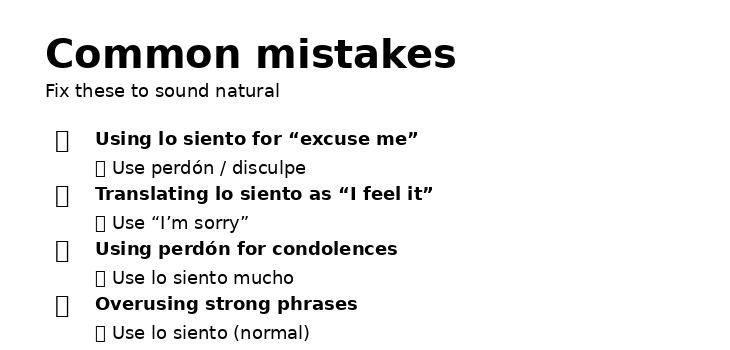
Mistake 1: Using lo siento for “excuse me”
❌ Lo siento, ¿puedo pasar?
✅ Perdón / Disculpe, ¿puedo pasar?
→ Excuse me, can I get through?
Mistake 2: Using perdón for serious sympathy
❌ Perdón por tu pérdida
✅ Lo siento mucho por tu pérdida
→ I’m very sorry for your loss.
Mistake 3: Translating lo siento as “I feel it”
❌ I feel it (not natural in English here)
✅ I’m sorry / I’m sorry to hear that
10) Mini Dialogues (Spanish + English)
Dialogue 1: Being late
Spanish:
Llegaste tarde.
Lo siento. Había tráfico.
English:
You’re late.
I’m sorry. There was traffic.
Dialogue 2: Bad news
Spanish:
Perdí mi trabajo.
Lo siento mucho.
English:
I lost my job.
I’m really sorry.
Dialogue 3: Asking a stranger
Spanish:
Disculpe, ¿dónde está el metro?
English:
Excuse me, where is the subway?
11) Quick Practice Table (Choose the right phrase)
| Situation | Best Spanish | English |
| You step on someone’s foot | Perdón | Sorry |
| You want to pass through a crowd | Perdón / Disculpe | Excuse me |
| You forgot to reply | Lo siento | I’m sorry |
| Someone is grieving | Lo siento mucho | I’m very sorry |
| You want attention politely | Disculpe | Excuse me |
| You broke something | Lo siento | I’m sorry |
FAQs (“lo siento in English”)
What does lo siento mean in English?
Lo siento in English means “I’m sorry.”
Can lo siento mean “excuse me”?
Usually no. For “excuse me,” Spanish often uses perdón or disculpe/disculpa.
What is the difference between lo siento and perdón?
- Lo siento = serious apology, regret, sympathy
- Perdón = small “sorry,” quick “excuse me,” minor accidents
Is lo siento much stronger than lo siento?
Yes. Lo siento mucho means “I’m very / really sorry.”
Final Summary
- Lo siento in English = “I’m sorry.”
- Use it for real apologies, regret, and sympathy
- Use perdón / disculpa / disculpe for excuse me and small interruptions
- Translate based on context, not word-by-word

About Grayson
Grayson is a professional English language teacher and the founder of WordEncyclo. With years of teaching experience, he specializes in vocabulary development, etymology, and word usage. His mission is to make English words and their meanings accessible to learners at all levels through clear, accurate, and well-researched content.