If you searched “Leafs vs Leaves”, you’re probably stuck on one simple problem: is the plural of leaf spelled leafs or leaves? Maybe you’re writing an essay, a caption, or some website content and you don’t want to look silly because of one small word. The good news: the rule is actually very simple once someone explains it in clear language.
This guide will explain Leafs vs Leaves in easy English, show you when “leaves” is correct, and also explain the few times when “leafs” is actually okay.
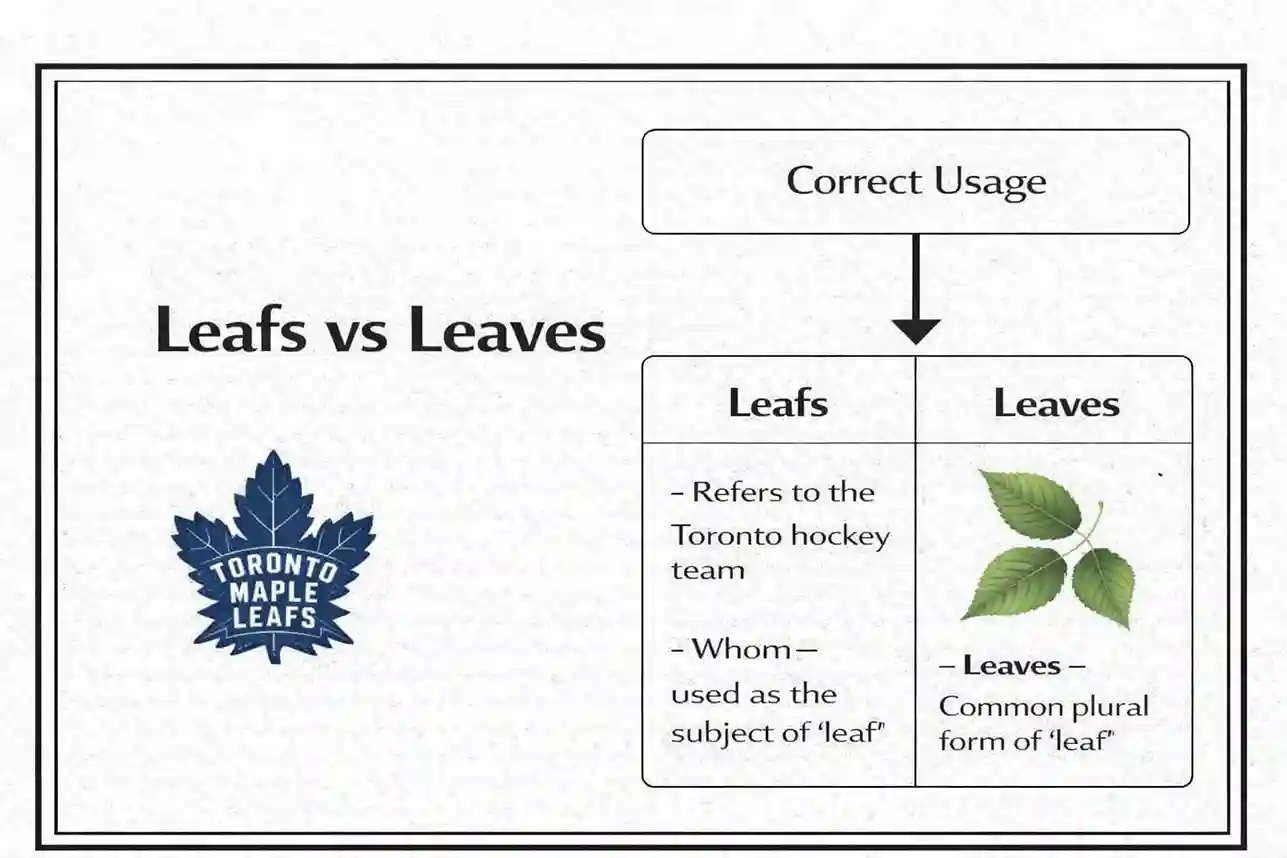
Short Answer: Leafs or Leaves?
Here is the quick, clear answer:
- ✅ Leaves is the correct plural of the noun leaf (the flat green part of a plant).
- ✅ Leafs is not the standard plural of leaf.
- ✅ Leafs can still be correct:
- as a verb form (he/it leafs through a book)
- as part of a name, like the hockey team Toronto Maple Leafs
So, if you are talking about more than one leaf on a tree or plant, you should write:
✅ leaves, not leafs.
Examples:
- The leaves are turning yellow.
- There are many leaves on the ground.
Now let’s look at why it works this way and when Leafs vs Leaves matters.
Leaf and Leaves – The Basic Rule
First, let’s look at the noun leaf.
Leaf (noun) = the thin, flat, usually green part of a plant or tree that grows from a stem or branch.
When we want to talk about more than one leaf, English does not just add -s. Instead, the word changes:
leaf → leaves
This follows a common pattern in English where some words ending in -f or -fe change to -ves in the plural.
Other words with the same change
- wolf → wolves
- knife → knives
- life → lives
- shelf → shelves
So:
- Not wolfs, but wolves
- Not knifes, but knives
- Not leafs, but leaves
This is why, in Leafs vs Leaves, the standard and correct plural is leaves.
When You Should Use “Leaves”
In almost all normal situations, if you are talking about more than one leaf, you should use leaves.
Here are common ways we use leaves in real life.
Talking about nature
- The leaves on the tree are very green.
- In autumn, the leaves change color and fall.
- There are dry leaves all over the ground.
Talking about plants and food
- Please wash the leaves of the lettuce before eating.
- Some teas are made from dried leaves.
- Spinach leaves are full of vitamins.
Talking about books and paper (older style)
Sometimes, a leaf can also mean a sheet of paper in a book or notebook. In this meaning too, the plural is leaves:
- Several leaves were missing from the old book.
- The diary had loose leaves of paper inside.
In all of these, the correct plural in Leafs vs Leaves is still leaves.
When “Leafs” Can Be Correct
Now, if “leaves” is the normal plural of leaf, why do we ever see “leafs” written anywhere?
There are two main reasons:
Leafs as a verb
Leaf is not only a noun. It can also be a verb:
to leaf (through) = to turn the pages of a book or magazine quickly, just looking briefly.
When we use leaf as a verb in the present tense, third person singular (he/she/it), it becomes:
he leafs, she leafs, it leafs
Examples:
- He leafs through the magazine while waiting.
- She leafs through her notebook, looking for the right page.
- The librarian leafs carefully through the old document.
Here, leafs is a verb form, not a plural noun.
It is correct grammar in this use.
So in Leafs vs Leaves:
- As a noun (more than one leaf) → leaves
- As a verb (he/she/it leafs) → leafs
Leafs in names and brands
Sometimes, people or companies choose their own spellings for names. Names do not always follow grammar rules.
The most famous example is the hockey team:
- Toronto Maple Leafs
Here, Leafs is part of the team’s name. Names are special. We do not “correct” them, even if they don’t follow normal grammar patterns.
So we say:
- The Toronto Maple Leafs won the game.
- He plays for the Maple Leafs.
Even though the normal plural of leaf is leaves, the name of the team uses Leafs. That is their choice, and names are allowed to break rules.
You might also see Leafs in:
- company names
- product names
- brand names
- usernames or titles online
For example (imaginary examples):
- Green Leafs Café
- Lucky Leafs Gaming
These are also names, so the spelling is a style choice, not a grammar rule.
Leafs vs Leaves – Quick Comparison Table
Here is an easy table to help you remember Leafs vs Leaves.
| Form | Part of speech | When it is correct | Example |
|---|---|---|---|
| leaf | noun (singular) | One leaf | This leaf is yellow. |
| leaves | noun (plural) | More than one leaf | These leaves are yellow. |
| leafs | verb (he/she/it) | Present tense of “to leaf (through)” | He leafs through the book. |
| Leafs | proper noun | Part of a name (team, brand, etc.) | He plays for the Maple Leafs. |
If you are writing about plants, trees, and nature, and you need the plural, leaves is almost always the right answer.
Common Mistakes with Leafs vs Leaves
Let’s look at some mistakes people often make, and fix them in easy language.
Mistake 1: Using “leafs” as the plural of leaf
❌ The tree’s leafs are falling.
✅ The tree’s leaves are falling.
❌ There are many brown leafs on the ground.
✅ There are many brown leaves on the ground.
If you are talking about more than one leaf, always write leaves, not leafs.
Mistake 2: Thinking “Leafs” is always wrong
This is also a mistake.
Many people think Leafs is always bad English, but that’s not true.
These are correct:
- He leafs through the pages every night. (verb)
- They support the Maple Leafs. (name)
So in Leafs vs Leaves, it’s not that Leafs is always wrong. It’s wrong only when you try to use it as the plural of the noun leaf in normal writing.
Mistake 3: Confusing “leafs” with “leaves” for the verb “leave”
Another common confusion is between leaf/leaves (plant) and leave/leaves (go away).
These are different words:
- leaf / leaves – plant parts
- leave / leaves – go away, depart
Examples:
- The leaves are falling from the tree. (plants)
- He leaves the house at 8 a.m. (he goes out)
They look similar, but they are not the same verb or noun.
So be careful not to mix leaves (plural of leaf) with leaves (he/she leaves = from the verb “leave”). They are spelled the same, but the meaning is different.
Many Example Sentences with Leaves
To make Leafs vs Leaves feel natural, let’s see more sentences using leaves correctly.
Nature and seasons
- In spring, new leaves grow on the trees.
- In autumn, the leaves turn red, orange, and yellow.
- The wind blew the leaves across the yard.
- The leaves of this tree are very large.
- Rain fell on the leaves, making them shine.
Plants and food
- She added mint leaves to the tea.
- The salad was made with fresh spinach leaves.
- The herb leaves have a strong smell.
- Some insects eat only certain leaves.
- We picked the outer leaves from the cabbage.
Books and paper
- Several leaves of the old manuscript were damaged.
- The notebook’s leaves were covered in notes.
In all of these, leaves is the correct plural of leaf.
Example Sentences with Leafs (Verb Form)
Now, some sentences where leafs is correct because it is a verb:
- Every evening, he leafs through a few pages before bed.
- She leafs through the catalog to choose a dress.
- The student leafs through his notes before the test.
- He quickly leafs through the dictionary to find the word.
If you can replace leafs through with “turns the pages of”, the verb meaning is correct.
Mini Practice: Leafs vs Leaves
Try this small practice to check your understanding. Choose leafs or leaves.
- There are many ___ on the path after the storm.
- She ___ through the magazine while drinking coffee.
- The tree loses its ___ every winter.
- He always ___ through the book instead of reading it carefully.
- We picked some fresh ___ for the salad.
Answers
- leaves → There are many leaves on the path after the storm.
- leafs → She leafs through the magazine while drinking coffee.
- leaves → The tree loses its leaves every winter.
- leafs → He always leafs through the book instead of reading it carefully.
- leaves → We picked some fresh leaves for the salad.
If you got most of these right, you understand Leafs vs Leaves very well.
Simple Way to Remember Leafs vs Leaves
Here is an easy memory trick:
- If you are talking about plants, trees, salad, or nature, and you need the plural → think of wolf/wolves, knife/knives, leaf/leaves.
→ use leaves. - If the word is acting like a doing word (he/she/it ___ through pages) → use leafs (verb).
- If it is part of a team name or brand name → spell it the way the name uses it (for example, Maple Leafs).
You almost never need leafs as a plural noun in normal English writing.
For your articles, essays, and posts, leaves is the safe and correct choice.
Final Summary – Leafs vs Leaves
To finish, here is the main idea of Leafs vs Leaves in very simple words:
- Leaf = one leaf.
- Leaves = more than one leaf (correct plural of the noun).
- Leafs = present tense verb form (he/she/it leafs through a book) or part of a name (like Maple Leafs).
- When you talk about plants or trees, and you want the plural, always write leaves, not leafs.
So next time you are writing and your brain asks “Leafs or Leaves?”, choose:
✅ Leaves for the plural noun
✅ Leafs only for the verb or a proper name

About Grayson
Grayson is a professional English language teacher and the founder of WordEncyclo. With years of teaching experience, he specializes in vocabulary development, etymology, and word usage. His mission is to make English words and their meanings accessible to learners at all levels through clear, accurate, and well-researched content.