
You’re writing a message:
“I got layed off last week.”
or
“I got laid off last week.”
You pause.
Something feels wrong, but you’re not sure which one.
This is where “Laid Off or Layed Off” becomes a real problem.
You might be updating your LinkedIn, talking to a recruiter, or writing your resume summary, and you don’t want a basic spelling mistake in such an important line.
Let’s clear it up with simple, calm English.
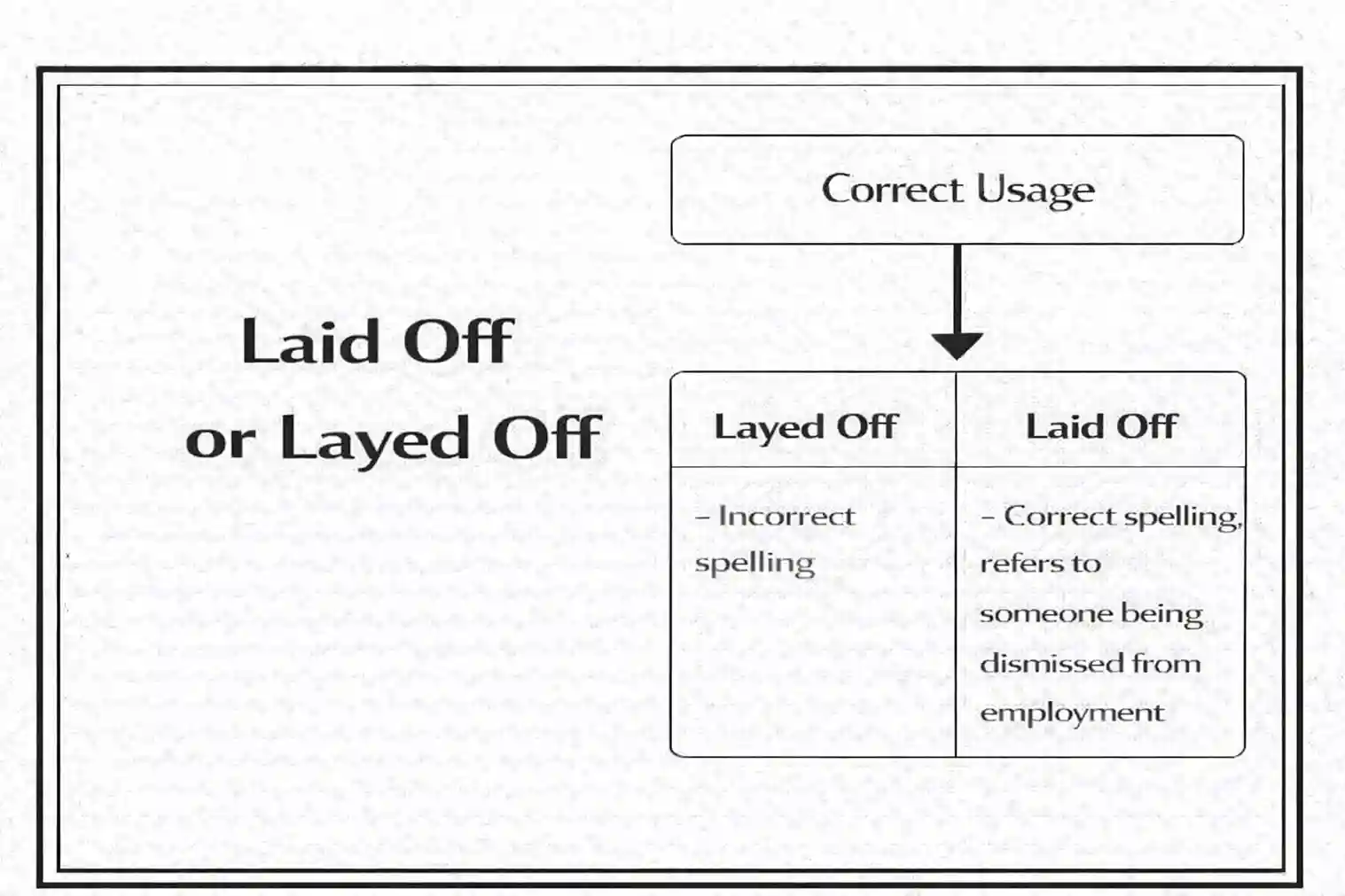
Quick Rule: Laid Off or Layed Off?
The correct spelling is:
✅ laid off
❌ layed off
In standard English, “layed off” is always incorrect in the job context.
Modern dictionaries like Merriam-Webster and Cambridge Dictionary only list laid as the past tense and past participle of lay, not layed.
So for work and career writing:
- “I was laid off last year.” ✅
- “I was layed off last year.” ❌
Now let’s understand why.
Why “Laid Off” Looks Wrong but Is Right
Many people want to write layed off because English often makes the past tense by adding -ed:
- walk → walked
- call → called
- plan → planned
- play → played
So your brain thinks:
lay → layed
It feels logical.
But English has many irregular verbs that don’t follow the normal -ed rule:
- say → said
- pay → paid
- make → made
- lay → laid
So the right past tense is:
lay → laid, not layed
Because “lay off” is built from the verb “lay”, the correct phrase becomes:
lay off → laid off
That’s why, in the choice Laid Off or Layed Off, the safe answer is always laid off.
What “Laid Off” Actually Means (In Work Life)
Laid off is a work / employment phrase.
It describes losing your job for reasons that are not your fault.
Usually, someone is laid off because:
- the company is cutting costs
- the company is restructuring
- a project was shut down
- the business is closing or shrinking
- the role is no longer needed
So:
- Laid off = job ended for company/business reasons
- Fired = job ended because of your performance or behavior
In simple words:
Laid off sounds softer and more neutral.
It does not mean “you were bad at your job.”
Examples:
- “I was laid off due to budget cuts.”
- “Half the team got laid off when the company merged.”
- “She was laid off after the department closed.”
Never use layed off here. It weakens your writing and looks unprofessional.
Forms of the Verb – Lay Off, Laid Off, Laying Off
Let’s look at all the forms you might need.
Base phrasal verb: lay off
| Tense / Form | Correct form | Example |
|---|---|---|
| Base | lay off | They plan to lay off some staff. |
| -ing (present) | laying off | The company is laying off workers. |
| Past simple | laid off | I was laid off last month. |
| Past participle | laid off | He has been laid off twice in five years. |
Notice:
We never write layed off in any of these forms.
Laid Off or Layed Off in Real Sentences
To make it stick in your head, here are lots of correct sentences you can copy and adapt.
Talking about your experience
- “I was laid off from my previous role when the company downsized.”
- “I recently got laid off, so I’m exploring new opportunities.”
- “Our whole team was laid off after the merger.”
- “I’ve been laid off twice due to company closures, not performance issues.”
Talking about the company’s actions
- “The company laid off 200 employees last quarter.”
- “They are laying off staff across several departments.”
- “Management decided to lay off the entire regional office.”
Talking about someone else
- “He was laid off when the project ended.”
- “She got laid off, but she found a new job quickly.”
- “Many workers were laid off during the pandemic.”
Every time, the spelling is laid off, never layed off.
Is “Layed” Ever Correct for Anything?
For modern standard English:
No, “layed” is not considered correct.
Most style guides and dictionaries only accept laid.
You might see “layed” sometimes:
- in old texts from centuries ago
- as a spelling error in social media or comments
- from people who are unsure about the grammar
But for your content, resume, or professional writing:
- you should treat layed as wrong spelling
- always use laid
That includes eggs:
- “The hen laid an egg.” ✅
- “The hen layed an egg.” ❌
So the safe rule:
Don’t use layed at all.
Use laid for past forms of lay, including laid off.
Don’t Mix “Laid Off” with “Lied” and “Lay” and “Lie”
This is where English gets a bit messy, but we’ll keep it simple.
There are two different verbs:
- lay – to put something down
- lie – to rest or recline (or to not tell the truth)
Because they are similar, they confuse a lot of people.
Verb 1 – lay (put something down)
- I lay the book on the table. (now)
- I laid the book on the table. (past)
- I have laid the book on the table. (past participle)
When you add “off” for jobs:
- They lay off staff.
- They laid off staff.
- They have laid off staff.
Verb 2 – lie (to rest / recline)
- I lie on the sofa. (now)
- I lay on the sofa yesterday. (past)
- I have lain on the sofa all day. (past participle)
Different verb, different pattern.
So:
- laid off = from lay off (job) ✅
- lied = from “lie” meaning “not tell the truth”
- lay = past of “lie” (recline)
This is why your brain can feel confused.
But for the job phrase “Laid Off or Layed Off”, you don’t need to learn everything, just remember:
Job phrase = laid off
There is no “layed off” in correct English.
How to Talk About Being Laid Off (Without Sounding Weak)
Since you’re writing about “Laid Off or Layed Off”, you’re probably also talking about your own layoff.
The spelling is one part of it.
The other part is how you present it.
Here are some ways to sound clear and confident.
On your resume
You don’t usually need to mention “laid off” directly in the bullet points.
Just show your achievements.
But you might explain the layoff in a short note or cover letter. Use laid off, not layed off:
- “Position ended when the company laid off 40% of staff.”
- “Role eliminated during a company-wide layoff.”
- “Left after being laid off due to restructuring.”
On LinkedIn “About” section
You can be honest but positive:
- “Recently laid off due to company restructuring; now looking for a new role where I can apply my skills in X and Y.”
- “After being laid off from my previous position, I’m focusing on new opportunities in [industry].”
In an email to a recruiter or hiring manager
- “I was laid off in December when my employer closed the local office, and I’m now available for full-time work.”
- “My last role ended when the company laid off several teams, including ours.”
Every time you write about your situation, using laid off (correct spelling) helps you look professional and careful with language.
Memory Tricks for Laid Off vs Layed Off
Here are a few simple tricks to lock the spelling into your mind.
1. Match it with “paid”
Think of another irregular verb that acts the same way:
- pay → paid
- lay → laid
So:
- paid off ✅
- laid off ✅
- NOT payed off ❌
- NOT layed off ❌
2. Think “laid = said”
- say → said
- lay → laid
The pattern of changing “ay” to “ai” appears in both.
3. Spell it out
Say this in your head:
“I got laid off, not layed off.”
Repeating that line a few times really helps.
Laid Off or Layed Off – Quick Comparison Table
You can use this table in your article for quick SEO-friendly clarity.
| Phrase | Correct? | Explanation |
|---|---|---|
| laid off | ✅ Yes | Correct past form of “lay off” (lose a job) |
| layed off | ❌ No | Common spelling mistake, not standard English |
| was laid off | ✅ Yes | Correct passive form |
| got laid off | ✅ Yes | Informal but common form |
| have been laid off | ✅ Yes | Correct present perfect form |
FAQ – Laid Off or Layed Off?
A. The correct spelling is laid off. Layed off is not accepted as standard English.
A. Historically you might find “layed” in very old writing, but in modern English it is treated as a spelling mistake. Use laid instead.
A. No. Being laid off usually means the company had financial or structural reasons. It is different from being fired for poor performance or behavior.
A. No major variety of standard English (American, British, etc.) treats layed off as correct. Laid off is the proper form everywhere.
A. Yes. It is informal but very common and natural:
“I got laid off last month.”
For more formal style, you can say: “I was laid off last month.”
Final Wrap-Up – Laid Off or Layed Off?
Let’s finish with the key points in simple words:
- When you talk about losing a job for company reasons, the correct phrase is laid off.
- Layed off is a spelling mistake and should be avoided in all serious writing.
- The base verb is lay, and its correct past form is laid, not layed.
- Use laid off in your resume, LinkedIn profile, emails, and articles to look careful and professional.
- If you’re ever unsure, remember: pay → paid, lay → laid → laid off, never layed off.
So the answer to the question “Laid Off or Layed Off?” is clear and final:
✅ Write laid off every time.

About Grayson
Grayson is a professional English language teacher and the founder of WordEncyclo. With years of teaching experience, he specializes in vocabulary development, etymology, and word usage. His mission is to make English words and their meanings accessible to learners at all levels through clear, accurate, and well-researched content.