
Picture graduation day.
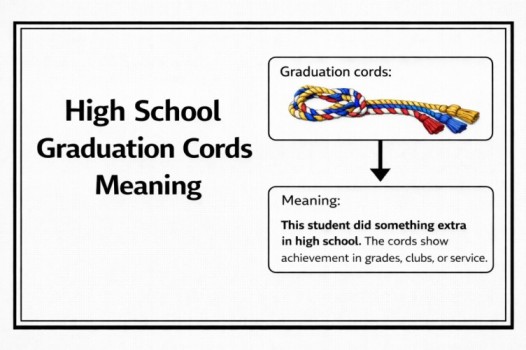
The band is playing, everyone’s in caps and gowns, and some seniors walk in with colorful ropes hanging around their necks. Parents whisper, “What do those mean?” and a lot of students aren’t totally sure either.
Those ropes are graduation cords, and they actually tell a quiet little story about each student. This guide breaks down the high school graduation cords meaning in the same structure you liked before, just using easier, more natural language.
What Are Graduation Cords?
Graduation cords are:
- long, thin ropes with tassels on both ends
- usually made of shiny material
- one solid color or two colors twisted together
- worn around the neck, on top of the gown
They are not random decoration.
At most schools, a cord means:
“I did something extra during high school, and the school wants to show it.”
That “something extra” might be strong grades, service hours, leadership, a special program, or time spent in a club or activity.
So the basic high school graduation cords meaning is:
visible credit for hard work and involvement.
Cords, Stoles, and Medals: What’s the Difference?
People often mix these up, so here’s a quick cheat sheet:
- Cords – Thin ropes. Hang straight down in front.
- Stoles/Sashes – Wide cloth that sits across the shoulders like a scarf. Often used by honor societies, cultural groups, and leadership groups.
- Medals/Medallions – A medal on a ribbon around the neck, usually for big awards like valedictorian or special honors.
All three are ways to show achievement, but this article is only about high school graduation cords meaning.
Who Decides What Each Cord Means?
There isn’t one big national rule book that says:
“Gold = GPA, red = leadership, blue = this, green = that.”
Instead, the meanings are set by:
- your high school
- your school district
- and sometimes national groups (like National Honor Society)
That means the same color might mean different things at different schools.
For example:
- At one school, a gold cord might mean “Honor Graduate.”
- At another, gold might belong only to National Honor Society.
- A third school might use gold for band seniors.
So if you want to know the exact high school graduation cords meaning at your school, always check:
- the graduation program
- your counselor
- the school website
- or the sponsor of the club or honor society
Still, there are some colors that are commonly used in similar ways.
Common Cord Colors and Their Usual Meanings
These are typical uses, not strict rules. Think of this table as a starting point, not the final word.
| Color / Combo | What It Often Means in High Schools |
|---|---|
| Gold / Yellow | High GPA, honor graduate, academic excellence |
| White | National Honor Society, general academic honors |
| Red | Leadership, student government, certain honor societies |
| Blue (light or dark) | Clubs, national organizations, social studies or science/math honors |
| Green | Environmental clubs, science or health programs, agriculture at some schools |
| Purple | Fine arts (choir, band, theater) or very high honors |
| Silver / Gray | Community service, technology/STEM, second-level honors |
| Black | JROTC, school-specific awards, or used with another color |
| Two-color cords | Usually a specific club or honor society at that school |
Again: the high school graduation cords meaning in your building might look a little different, but this gives you the general idea.
What Do Graduation Cords Usually Represent?
Most cords fall into a few big categories. The color just shows which category and which group.
1. Academic Honors (Grades)
Some cords are all about grades.
Schools might give cords to students who:
- kept a certain GPA (for example, 3.5 and above)
- finished a number of honors or AP classes
- ranked near the top of the class
Sometimes there are different levels: one cord for honors, two for high honors, three for highest honors. Names like cum laude or summa cum laude might show up too.
In simple terms, the high school graduation cords meaning here is:
“I worked hard in class and kept strong grades over four years.”
2. Honor Societies
Honor societies mix grades, service, and character.
Examples:
- National Honor Society
- science, math, or language honor societies
- art or music honor societies
To get one of these cords, students usually must:
- keep up a certain GPA
- attend meetings
- do service hours
- follow the group’s behavior rules
So these cords mean:
“I kept good grades and took part in this honor group.”
3. Clubs and Activities
Many schools give cords for clubs and activities, such as:
- band or orchestra
- choir
- theater / drama club
- JROTC
- student council
- yearbook or school newspaper
- service clubs
These cords usually require more than just signing up once. They’re often for students who:
- stayed in the group for several years
- came to practices, meetings, and events
- sometimes held leadership roles
So the high school graduation cords meaning here is:
“I showed up, participated, and helped this group for a long time.”
4. Special Programs and Pathways
Some schools have special tracks, like:
- health science academy
- engineering or robotics pathway
- business and marketing program
- culinary, automotive, or other career programs
- dual-language or immersion programs
Finishing all the requirements in one of these programs can earn a special cord.
This cord says:
“I completed a focused program, not just the basic graduation checklist.”
How Do Students Earn Graduation Cords?
Cords are usually earned, not just handed out. Schools and organizations set their own rules.
Common requirements include:
- Grades – keeping a minimum GPA
- Years of membership – staying active in a club or honor society
- Service hours – volunteering in school or community projects
- Leadership – serving as an officer, captain, editor, or section leader
- Program completion – finishing all levels of a certain pathway
Near graduation, schools or clubs make a list of seniors who met all the requirements. Those students are the ones allowed to pick up and wear that cord.
The big picture: the high school graduation cords meaning is tightly connected to effort over time, not just one good semester.
How and When to Wear Graduation Cords
Putting them on is easy.
- Put on your graduation gown and zip it.
- Take the cord and place the middle of it at the back of your neck.
- Let both ends hang down the front of your gown.
- Straighten them so the two sides hang evenly.
- If you have more than one cord, layer them neatly.
A couple of simple tips:
- Don’t tie the cords in knots or bows—they’re meant to hang straight.
- If they slide around, you can use a small safety pin on the inside of the gown near the collar.
- Follow any school rules about how many cords, stoles, and medals you can wear on stage.
During the ceremony and in photos, cords make it easy to see that a student has extra honors or involvement.
Why Graduation Cords Matter Emotionally
From a distance, cords are just colored ropes. But for many students, each cord holds memories.
A gold cord might remind someone of:
- late-night study sessions
- asking teachers for help
- retaking tests to raise grades
A cord from a club or team might bring back:
- bus rides to games or competitions
- concerts, shows, and performances
- friends made along the way
A service cord might represent:
- time spent tutoring
- working at food drives or charity events
- helping at school functions
For families, cords are a clear sign that their student didn’t just “get through” high school. They engaged with it. That’s a big part of the high school graduation cords meaning that doesn’t show up in any official rule book.
How to Find Out What Cords Mean at Your School
If you’re a student planning ahead—or a parent just trying to decode all the colors—here are easy ways to get the exact details:
- Ask your counselor.
“Can you tell me what the different graduation cords mean here?” - Talk to club sponsors and honor society advisers.
They’ll know their own cord colors and requirements. - Check the school website or student handbook.
Some schools list honors and regalia in the graduation section. - Look at photos from last year’s graduation.
If you see seniors wearing certain cords, you can ask what they were for.
Once you know the system, you can set goals. Maybe you want to aim for:
- a GPA cord
- an honor society cord
- or a cord from a program or activity you love
Quick FAQ on High School Graduation Cords Meaning
No. Some students have several cords, some have one, and some have none. You can still be proud of graduating even without cords.
Yes. The main goal is the diploma. Cords are extra recognition, not a requirement.
It depends. Some cords are free, some are covered by club fees, and some schools ask students to pay a small amount if they want to keep them. Always ask if cost is a worry—there may be help.
Some schools allow this, others only allow school-issued cords. Check with your counselor or the person running the ceremony.
Most schools expect students to wear what they’ve earned. It’s a way to celebrate effort, not to brag. As long as you’re respectful, it’s okay to be proud of your cords.
Short, Simple Summary
Here’s the high school graduation cords meaning in everyday words:
Graduation cords are colored ropes worn over the gown. Each color usually stands for something a student did—good grades, honor societies, clubs, service, or special programs. Schools decide what each color means. When you see cords on a student, it’s a sign that they went beyond the basic requirements and their school is recognizing that work.
That’s it: same structure, simpler language, and ready to use on your site or with your readers.

About Grayson
Grayson is a professional English language teacher and the founder of WordEncyclo. With years of teaching experience, he specializes in vocabulary development, etymology, and word usage. His mission is to make English words and their meanings accessible to learners at all levels through clear, accurate, and well-researched content.