If you’ve ever seen a wooden sign that says “E Komo Mai” by a front door, or you heard it in a movie, or at a hotel in Hawaiʻi, you might have wondered:
“What does that actually mean?”
The phrase looks beautiful, but if you don’t speak Hawaiian, it’s not obvious. The nice thing is: the e komo mai meaning is easy to understand. Once you learn it, you’ll start to notice that people use it in very specific moments, and you’ll be able to use it yourself in a natural way.
In this guide, we’ll break it down in simple, human language. No fancy jargon, no confusing grammar talk. Just:
- what “E Komo Mai” means,
- how to say it,
- when to use it,
- and real examples you can copy.
What Does “E Komo Mai” Mean?
Let’s start with the main thing you care about.
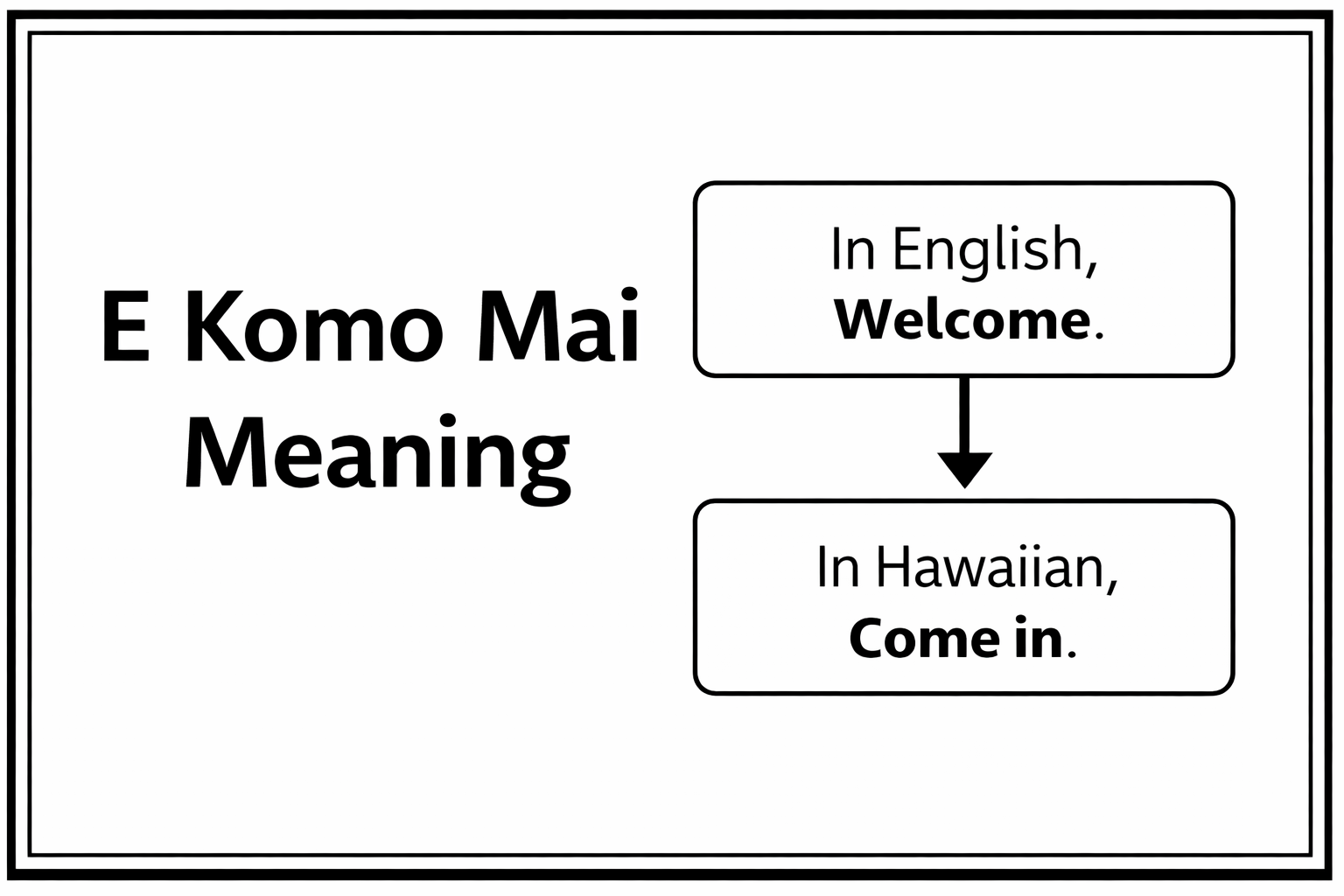
The e komo mai meaning in English is:
“Welcome.”
More fully, it often feels like:
- “Welcome, come in.”
- “Please enter.”
- “You’re welcome here.”
So if you see “E Komo Mai” on a sign at a door, the message is basically:
“Welcome, come inside.”
It’s not used as a random “hello,” and it’s not used as “goodbye.”
It’s mainly for moments when someone is entering a place or being let in.
A Simple Word-by-Word Breakdown
Now let’s look at the parts of the phrase. You don’t need to become a language expert. This is just to help you understand why the e komo mai meaning feels like an invitation.
| Part | Simple meaning | What it does in the phrase |
|---|---|---|
| E | “please” / invitation | Makes it sound like a polite call or command |
| Komo | “enter” / go in | Describes the action: to come in |
| Mai | “toward here” | Shows the direction: come this way, toward us |
Put together, it’s something like:
“Please enter (toward here).”
In normal English, we don’t say it that way, so we turn it into:
“Welcome” or “Welcome, come in.”
That’s why people put it at entrances, not in random places.
How to Pronounce “E Komo Mai”
You don’t have to stress about pronunciation. You just need something close and respectful.
A simple pronunciation:
“eh KOH-moh my”
Here’s a quick guide:
| Part | Sounds like |
|---|---|
| E | “eh” (like in “get”) |
| Komo | “KOH-moh” |
| Mai | “my” |
Say it smoothly:
eh KOH-moh my
You don’t need to force an accent or try to sound “extra local.” Just speak clearly and with a warm tone. The feeling matters as much as the sound.
Where You’ll Usually See “E Komo Mai”
Because the e komo mai meaning is “welcome / come in,” you’ll almost always find it in places connected to arriving or entering.
Here are some common spots:
At Home Entrances
People put “E Komo Mai” on:
- front door signs
- welcome mats
- wooden plaques
- entry walls
In this case, it’s basically the Hawaiian version of:
“Welcome to our home.”
At Events and Gatherings
You might hear an organizer or host say:
“E Komo Mai, everyone. Thank you for coming.”
Here it’s like saying:
“Welcome, we’re glad you’re here. Come in and join us.”
In Shops, Cafés, and Offices
Businesses sometimes use “E Komo Mai” in:
- welcome signs
- menus
- door stickers
- reception desks
The idea is:
“Welcome in. Come inside, you’re invited to step in.”
Online and in Invitations
Some people use “E Komo Mai” at the top of:
- event invitations
- websites
- welcome sections
- group descriptions
Even online, the e komo mai meaning is still the same:
you’re being welcomed into something.
Quick Overview Table
| Place / context | What “E Komo Mai” is doing there |
|---|---|
| Front door sign | Welcoming guests into a home |
| Event entrance | Welcoming people into the gathering |
| Storefront | Inviting customers to come inside |
| Reception desk | Inviting visitors to step up and check in |
| Website / group page | Symbolically welcoming people into a space or community |
In every case, someone is entering, and someone is welcoming.
That’s the heart of the e komo mai meaning.
“E Komo Mai” vs “Aloha”
These two words often appear next to each other, so it’s easy to mix them up. Let’s keep it simple.
Aloha is a general greeting and farewell. It can mean:
- hello
- goodbye
- and it also has deeper meanings like love and compassion
E Komo Mai is more specific. It’s about welcoming in.
Here’s a small comparison:
| Phrase | Everyday meaning | Good moment to use it |
|---|---|---|
| E Komo Mai | Welcome / Come in | When someone is entering |
| Aloha | Hello / Goodbye | When greeting or saying farewell |
So:
- If someone is just walking past you → Aloha fits.
- If someone is walking into your house or event → E Komo Mai fits.
An easy rule:
If “Come in” makes sense in English, “E Komo Mai” makes sense in Hawaiian.
How to Use “E Komo Mai” in Real Life (With Examples)
Now let’s make it practical. Here are some real-life ways to use the phrase.
Welcoming Guests to Your Home
When someone shows up at your door, you could say:
- “E Komo Mai! Come in and make yourself at home.”
- “E Komo Mai—shoes can stay by the door.”
- “E Komo Mai! I’m so happy you’re here.”
Each one matches the e komo mai meaning: you’re telling them to enter and feel welcome.
Welcoming People to an Event
At the start of a party, ceremony, or gathering:
- “E Komo Mai, everyone. Thank you for joining us today.”
- “E Komo Mai—please sign in and find a seat.”
- “E Komo Mai, and welcome to our celebration.”
Again, people are arriving. You’re opening the “door,” even if it’s a mental one.
Welcoming Customers or Clients
In a shop, office, or café:
- “Aloha, E Komo Mai—let us know if you need anything.”
- “E Komo Mai! We’re glad you stopped by today.”
- “E Komo Mai—please come in and check in at the front desk.”
You’re inviting them to step inside, ask questions, or start the visit.
Online Uses
On a website, blog, or group page, you might see:
- “E Komo Mai — Welcome to Our Community”
- “E Komo Mai — We’re Happy You’re Here”
- “E Komo Mai — Join Us and Feel at Home”
Even though it’s digital, the idea of entering still works. They’re joining a space.
Short Dialogues Using “E Komo Mai”
Sometimes it helps to see tiny conversations where the phrase fits naturally.
Dialogue 1: House Visit
Host: E Komo Mai!
Guest: Mahalo, it’s great to see you.
Here, “E Komo Mai” is the first thing said when the door opens.
Dialogue 2: Event Check-In
Organizer: E Komo Mai—please sign in right over here.
Visitor: Thank you!
The phrase appears right at the moment of entering the event area.
Dialogue 3: Escaping the Heat
You: It’s really hot outside—E Komo Mai, come in and cool off.
Friend: Yes, please, thanks!
Again, the person is being invited to come inside.
Ready-Made Lines for Signs and Posters
If you’re planning to print or publish something, and you want to use “E Komo Mai” correctly, here are some ready-to-use ideas.
For a Home
- E Komo Mai — Welcome to Our Home
- E Komo Mai — Please Come In
- E Komo Mai — Friends and Family Always Welcome
- E Komo Mai — Make Yourself at Home
For a Vacation Rental / Airbnb
- E Komo Mai — Welcome to Your Stay
- E Komo Mai — We’re Glad You’re Here
- E Komo Mai — Enjoy Your Time Here
For an Event
- E Komo Mai — Welcome to Our Wedding
- E Komo Mai — Please Sign In and Join Us
- E Komo Mai — Thank You for Being Here
For a Shop or Café
- E Komo Mai — Come In, We’re Open
- E Komo Mai — Welcome In, Take a Look Around
- E Komo Mai — Step Inside and Say Aloha
All of these keep the e komo mai meaning clear: people are welcome to enter.
Common Mistakes (And Easy Fixes)
Because the phrase looks and sounds nice, some people throw it into random places. That’s when it starts to feel off.
Here are some common mistakes and better choices:
| Mistake | Why it doesn’t match the meaning | Better approach |
|---|---|---|
| Using it as “goodbye” | It means welcome/come in, not farewell | Use “Aloha” for goodbye |
| Using it as a casual “hello” in the street | It’s tied to entering, not just any greeting | Use “Aloha” as a general greeting |
| Using it in a context with no “entry” idea | The phrase implies entering or joining | Save it for doors, events, groups, or welcoming text |
If you always connect “E Komo Mai” with the idea of someone coming in, you’ll naturally use it right.
Quick Reference Table: When “E Komo Mai” Fits
Here’s a fast cheat sheet you can mentally check.
| Situation | Does “E Komo Mai” fit? | Why |
|---|---|---|
| Guest at your front door | ✅ Yes | They’re entering your home |
| Customers walking into a store | ✅ Yes | They’re coming into the shop |
| People joining an event at the entrance | ✅ Yes | They’re entering a gathering |
| Saying bye to someone leaving | ❌ No | That’s a farewell |
| Saying hi to someone passing on the street | ⚠️ Not ideal | No clear “entry” happening |
Short FAQ About “E Komo Mai”
It means “welcome.” More specifically, it feels like “welcome, come in” or “please enter.”
No.
Aloha is hello, goodbye, and more.
E Komo Mai is about welcoming someone into a place or space.
Yes, absolutely. That’s one of the most natural uses, and it matches the e komo mai meaning perfectly.
You can say it like this:
“eh KOH-moh my”
Yes, as long as it’s used with respect and in the right context. If you’re using it to genuinely welcome people in, you’re in line with the basic meaning of the phrase.
Conclusion: The Heart Behind “E Komo Mai”
When you put everything together, the e komo mai meaning is simple but powerful:
It means “welcome,” especially in the sense of “welcome, come in.”
It’s not a random greeting. It’s an invitation. You use it when someone is entering your home, your event, your shop, your space, or even your online community. You’re telling them:
“You’re allowed in. You’re invited. We’re glad you’re here.”
If you remember just one rule, make it this:
Whenever “Come in” makes sense, “E Komo Mai” fits.
Use it at doors, entrances, and openings. Say it with a calm, friendly tone. Put it on signs that truly welcome people. When you do that, you’re using the phrase the way it’s meant to be used—clearly, correctly, and with a warm, human touch.

About Grayson
Grayson is a professional English language teacher and the founder of WordEncyclo. With years of teaching experience, he specializes in vocabulary development, etymology, and word usage. His mission is to make English words and their meanings accessible to learners at all levels through clear, accurate, and well-researched content.