
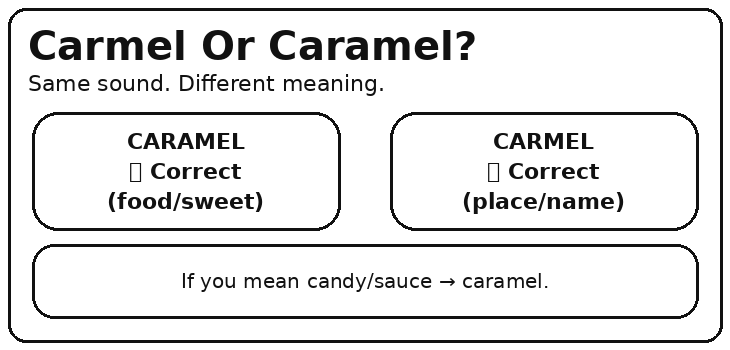
Let’s be honest: the carmel or caramel confusion usually happens in the same moment.
You’re typing fast. Maybe it’s:
- a caption like “carmel latte 😍”
- a menu item
- a recipe post
- a product title
- or a school/work sentence
And you pause because you’ve seen both spellings online. Plus, when people say the word out loud, it often sounds like “CAR-mel” anyway. So your brain goes:
Wait… is it caramel or carmel?
Here’s the most human answer:
- ✅ If you mean the sweet flavor (coffee syrup, candy, sauce, dessert topping) → it’s caramel
- ✅ If you mean a name or place (like Carmel, California / Mount Carmel / someone named Carmel) → it’s Carmel
- ❌ If you write carmel for a latte or sauce, it’s usually just a common misspelling
That’s the whole thing.
Now let’s make it so simple you never have to think about it again.
Carmel Or Caramel: The 5-Second Rule
If it belongs on a menu, use caramel.
If it belongs on a map, use Carmel.
Most people wish they learned this rule first.
Menu = caramel
- caramel latte
- caramel sauce
- caramel candy
- salted caramel ice cream
Map = Carmel
- Carmel, California
- Carmel-by-the-Sea
- Mount Carmel
Once you see it this way, the spelling stops being stressful.
Carmel Vs Caramel: Quick Comparison Table

| You Mean… | Write This | Quick Example |
|---|---|---|
| sweet flavor / syrup / candy / sauce | caramel | caramel latte |
| dessert topping | caramel | caramel drizzle |
| a town/city/name | Carmel | Carmel, California |
| Mount Carmel (place name) | Carmel | Mount Carmel |
| a person’s name | Carmel | “Carmel is my cousin.” |
Easy rule:
If it’s edible → caramel.
If it’s a name/place → Carmel.
Why People Mix Up Carmel Or Caramel (And It’s Not Your Fault)
You’re not mixing this up because you’re “bad at English.”
You’re mixing it up because English is messy, and the USA has multiple common pronunciations.
A lot of Americans say caramel like:
- CAR-mel (two syllables)
So when you hear “CAR-mel,” it feels logical to spell it carmel.
But spelling doesn’t always follow casual pronunciation. We do this in English all the time:
- people say “probly” but write probably
- people say “choc-lit” but write chocolate
- people say “cam-ra” but write camera
Same idea here:
You can say “CAR-mel,” but the standard spelling for the sweet food/flavor is still:
✅ caramel.
What “Caramel” Means (Plain, Everyday USA Meaning)
When Americans write caramel, they usually mean one of these:
1) Caramel sauce (the drizzle)
That thick sweet sauce you pour on ice cream, cheesecake, brownies, apples, pancakes—anything.
Examples
- “Add caramel sauce on top.”
- “This brownie has caramel drizzle.”
2) Caramel candy (chewy sweets)
Soft chewy candies that literally are caramel.
Examples
- “These caramel candies are so good.”
- “I bought a bag of caramel chews.”
3) Caramel as a flavor (coffee / desserts)
This is the most common use online.
Examples
- “Can I get a caramel latte?”
- “I love caramel ice cream.”
- “This cupcake has caramel filling.”
4) Salted caramel (super popular combo)
Sweet + salty. You see it everywhere now.
Examples
- “Salted caramel cookies.”
- “Salted caramel cold brew.”
If you’re talking about food, dessert, coffee flavors, syrup, drizzle, candy — you want caramel almost every time.
What “Carmel” Means (When It’s Actually Correct)
Carmel is usually not a food word. It’s usually a proper noun — meaning a specific name.
Here are the normal ways Carmel shows up:
1) Carmel as a place name (USA)
This is the big one.
Examples
- “We went to Carmel for the weekend.”
- “Carmel-by-the-Sea is gorgeous.”
- “We stayed near Carmel in California.”
2) Mount Carmel (a place name)
Used in geographic / historical / religious contexts.
Examples
- “Mount Carmel is a place name.”
- “The name Carmel appears in older texts and places.”
3) Carmel as a personal name
Less common, but real.
Examples
- “Her name is Carmel.”
- “Carmel works in our office.”
So Carmel is real — it’s just not what you usually mean when you’re describing a latte or dessert.
The Real-Life Problem: People Write “Carmel” When They Mean “Caramel”
Let’s call this what it is.
When someone writes:
- “carmel latte”
- “carmel sauce”
- “carmel candy”
…they almost always mean caramel.
It’s one of those spelling mistakes that spreads because it’s:
- common
- not always caught by spellcheck (because Carmel is a real word)
- reinforced by pronunciation
So for clean USA English writing:
✅ Use caramel for food/flavor.
Carmel Or Caramel In Coffee: The Most Common Mistake
If you’re searching carmel or caramel, there’s a good chance you mean coffee. This is where the typo happens constantly.
Correct coffee spellings (copy these)
- caramel latte
- caramel macchiato
- caramel iced coffee
- caramel syrup
- caramel drizzle
- salted caramel cold brew
Wrong versions you’ll see online (avoid these in writing)
- ❌ carmel latte
- ❌ carmel macchiato
- ❌ carmel syrup
- ❌ carmel drizzle
Quick examples (coffee)
- “Can I get a caramel latte?”
- “Add caramel drizzle.”
- “Do you have caramel syrup?”
- “This tastes like caramel.”
If it’s a drink flavor, write caramel.
Carmel Or Caramel In Desserts: Easy (If You Can Eat It, It’s Caramel)
Desserts are basically the “free point” category. If it’s sweet and edible, it’s caramel.
Correct dessert phrases
- caramel sauce
- caramel apples
- caramel popcorn
- caramel cheesecake
- caramel brownies
- caramel filling
- caramel icing
- salted caramel ice cream
Real dessert examples
- “These are caramel apples.”
- “I made caramel sauce.”
- “This cake has a caramel layer.”
- “Try the salted caramel ice cream.”
If it belongs on a menu or recipe card → caramel.
Carmel Or Caramel In Travel Writing: When Carmel Is Correct
Now flip the context.
If you’re writing about:
- a town
- a destination
- a road trip
- a hotel
- a place you visited
…that’s when Carmel shows up.
Correct travel examples
- “We drove to Carmel on the weekend.”
- “Carmel-by-the-Sea is a coastal town.”
- “Carmel is a great stop in California.”
This is the “map” side of the menu vs map rule.
The Two-Box Test (Fastest Real Writing Trick)
If you’re stuck between carmel or caramel, put your sentence into one of these boxes:
Box 1: Food / flavor / drink → caramel
Box 2: Person / place / name → Carmel
Try it:
- “I want a ___ latte.” → food/drink → caramel
- “We visited ___, California.” → place → Carmel
- “This cake has ___ filling.” → food → caramel
- “Mount ___ is a place name.” → place → Carmel
Pronunciation (USA): Why Spelling Feels Weird

In the USA, people commonly say caramel two ways:
- CARE-uh-mel (3 syllables)
- CAR-mel (2 syllables)
Both are normal.
But the spelling for the sweet flavor remains the same:
✅ caramel
So even if you say “CAR-mel sauce,” the correct writing is still:
✅ caramel sauce
Carmel Or Caramel: Grammar-Level Difference (Spelling Changes Meaning)
This isn’t just spelling — it’s also grammar and meaning.
Caramel Is A Common Noun (Usually Lowercase)
caramel is a common noun, like vanilla or chocolate. It usually stays lowercase because it’s a general thing.
Examples
- caramel candy
- caramel sauce
- caramel flavor
Carmel Is A Proper Noun (Usually Capitalized)
Carmel is usually a proper noun, so it’s capitalized because it names a specific place or person.
Examples
- Carmel, California
- Carmel-by-the-Sea
- Mount Carmel
- Carmel (a name)
Quick grammar rule:
Lowercase for food → caramel
Capital letter for name/place → Carmel
Vocabulary Upgrade: More Accurate Words Than Just “Caramel”
If you’re trying to improve vocabulary, these small word choices make your writing sharper.
If you mean the topping
- caramel sauce (thicker)
- caramel drizzle (lighter, decorative)
- caramel syrup (thin, used in drinks)
- caramel glaze (shiny coating)
Examples
- “Top it with a caramel drizzle.”
- “Add caramel syrup to the coffee.”
- “The dessert has a caramel glaze.”
If you mean the cooking effect (not the candy)
Use caramelized — this is a great vocabulary word.
Examples
- “The onions were caramelized until golden.”
- “The sugar caramelized quickly.”
This is a common learner mistake: caramel (food/flavor) vs caramelized (cooking action).
Common Mistakes (With Fixes You Can Copy)
Food mistakes (very common)
- ❌ carmel candy → ✅ caramel candy
- ❌ carmel sauce → ✅ caramel sauce
- ❌ carmel latte → ✅ caramel latte
- ❌ carmel drizzle → ✅ caramel drizzle
- ❌ carmel popcorn → ✅ caramel popcorn
- ❌ carmel macchiato → ✅ caramel macchiato
Place/name mistakes (less common)
- ❌ caramel, California (when you mean the town) → ✅ Carmel, California
- ❌ mount caramel → ✅ Mount Carmel
Fixing these instantly makes your writing look more polished.
Copy/Paste Sentence Bank (Clean + Correct)
Caramel (food/flavor)
- “This latte has a strong caramel flavor.”
- “Add caramel sauce on top.”
- “The dessert is finished with caramel drizzle.”
- “Try the salted caramel version.”
Carmel (name/place)
- “We visited Carmel, California.”
- “Carmel-by-the-Sea is a coastal town.”
- “Mount Carmel is a place name.”
Quick Practice
Correct the spelling:
- “I ordered a carmel latte.”
- “She made carmel sauce.”
- “We stayed in caramel, California.”
- “This brownie has carmel inside.”
- “Mount caramel is a place name.”
Correct answers
- caramel ✅
- caramel ✅
- Carmel ✅
- caramel ✅
- Carmel ✅
Mini Quiz (Fast)
Pick Carmel or caramel:
- ___ apple
- ___, California
- ___ syrup
- ___ candy
- Mount ___
Answers
- caramel ✅
- Carmel ✅
- caramel ✅
- caramel ✅
- Carmel ✅
FAQs (People Also Ask)
If it’s the sweet flavor/topping/candy/sauce → caramel.
If it’s a name/place → Carmel.
Because many Americans pronounce caramel like “CAR-mel,” and Carmel is a real word, so the typo looks “valid.”
In standard writing, no. The correct spelling is caramel latte.
Yes. It’s most often used as a proper noun (place name or personal name).
Both “CARE-uh-mel” and “CAR-mel” are common in the USA, but the spelling for the sweet flavor stays caramel.
Conclusion
If you’re choosing between carmel or caramel, don’t overthink it. Use the most practical rule: menu vs map.
- If you’re talking about a sweet food flavor (latte, sauce, candy, drizzle, desserts), the correct spelling is caramel
- If you’re talking about a place or name (like Carmel, California or Mount Carmel), the correct spelling is Carmel
The confusion happens because pronunciation varies across the USA, but the standard spelling for the sweet flavor doesn’t change.

About Grayson
Grayson is a professional English language teacher and the founder of WordEncyclo. With years of teaching experience, he specializes in vocabulary development, etymology, and word usage. His mission is to make English words and their meanings accessible to learners at all levels through clear, accurate, and well-researched content.