Sometimes you see people write sentences like:
- “I know one here.”
- “I no one here.”
Both look strange.
Then you remember phrases like “Know One or No One”, and it becomes even more confusing.
The problem is simple:
- “no one” is a correct and very common phrase.
- “know one” can also be correct, but it means something completely different.
- “noone” (one word) is not standard English.
This guide will explain everything in easy language, with lots of examples, so you can tell exactly when to use no one and when know one makes sense.
“No One” – What It Means and How We Use It
Basic meaning
“No one” means nobody.
It talks about zero people.
We use it when we want to say that there is not a single person who did something, knows something, or was present somewhere.
Think of it like this:
- no one = not any person
Simple sentence patterns with “no one”
You can use no one:
- at the beginning of a sentence
- in the middle
- or near the end
At the beginning
- No one answered the door.
- No one believed his story.
- No one wanted to leave early.
In the middle
- I told no one my password.
- She trusts no one at work.
- He invited no one from his old class.
At the end
- The room was full, but I knew no one.
- They looked around and saw no one.
- We spoke to everyone, and in the end we trusted no one.
In every case, “no one” is talking about people.
It never refers to things or objects. For things we use other words like nothing, none, no thing, etc.
“Know One” – A Completely Different Idea
Now, let’s look at “know one.”
Here we have two separate words:
- know – a verb (to know something or someone)
- one – the number 1, or “one person / one thing”
So “know one” is not a single phrase with a special meaning.
It simply means:
to know one person or one thing.
How “know one” appears in real sentences
You usually see know one followed by an idea that is clear from the context:
- I only know one person in this city.
- We know one thing: this will take time.
- She knows one good café nearby.
- They know one safe place to stay.
Sometimes the noun is written:
- I know one teacher who can help you.
- Do you know one restaurant that’s open late?
Sometimes the noun is just understood:
- I know one who can fix your car.
(Here “one” means “one mechanic / one person”.)
So the idea of “know one” is:
- you are not talking about nobody
- you are talking about exactly one person, place, or thing you know
It is never used in the same way as “no one”.
Know One or No One – Side-by-Side View
To see the difference more clearly, compare these two sentences:
I know one person here.
I know no one here.
They sound a little similar, but they have opposite meanings:
- I know one person here.
→ There is one person I know. - I know no one here.
→ I do not know any person here.
Here’s a quick comparison table:
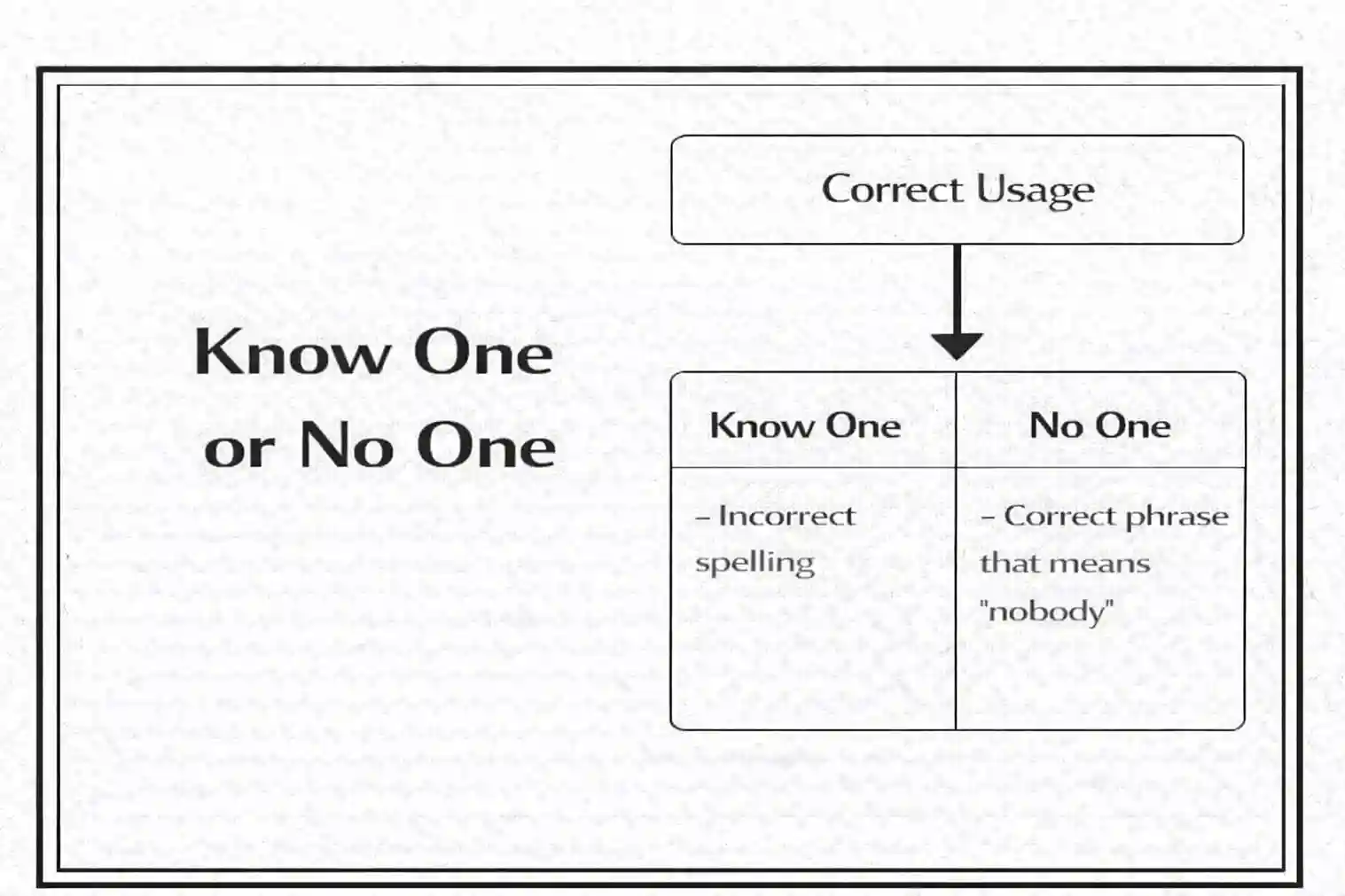
| Expression | Meaning in simple words | Example |
|---|---|---|
| no one | nobody, zero people | No one called me. |
| know one | know exactly one person / thing | I know one good doctor in this area. |
So when you’re looking at “Know One or No One”, you are actually choosing between:
- talking about nobody
- talking about one specific person or thing you know
Why “Noone” and “No-One” Cause Extra Confusion
This topic doesn’t stop at Know One or No One.
Many people also wonder:
- Is it no one, no-one, or noone?
Let’s sort them quickly.
“noone” – one word
Spelled as “noone”, it looks like someone or anyone.
But in standard English, “noone” is not correct.
You should avoid this spelling in proper writing, emails, essays, and articles.
“no-one” – with a hyphen
You may sometimes see no-one (with a hyphen) in books, especially older ones or some British writing. It is not “wrong,” but many modern style guides prefer the simpler form no one.
To keep your writing clean and modern:
- use no one (two words, no hyphen)
So your best choice is:
✅ no one
❌ noone
⚠ no-one (older or less common)
Many Example Sentences with “No One”
Let’s go deeper with no one, because this is the phrase you will use the most.
In personal life
- No one remembered my birthday except my family.
- No one waved back at me.
- No one stayed after the movie; everyone left fast.
- No one knew the new password for the Wi-Fi.
In school or college
- No one understood the last question on the test.
- No one handed in the homework on time.
- When the teacher asked for volunteers, no one raised their hand.
- No one wanted to be in that group project.
At work
- No one told me the meeting was canceled.
- No one explained the new rules clearly.
- No one replied to the email until Monday.
- No one was in the office when I arrived early.
In stories or writing
- No one saw the stranger enter the village.
- No one believed the child at first.
- No one could open the old door.
- No one expected what happened next.
In all these sentences, you could use “nobody” instead of “no one”, and the meaning would stay almost the same.
Many Example Sentences with “Know One”
Now let’s do the same thing with know one, so you can feel how different it is.
With people
- I only know one person at that party, so I might feel shy.
- She knows one neighbor very well; the others she barely meets.
- We know one lawyer who can give advice.
- They know one classmate who speaks the local language.
With places
- I know one quiet place where we can talk.
- He knows one shop that sells this brand.
- We know one hotel that’s cheap but clean.
- Do you know one café where we can sit and work?
With facts or ideas
- We know one thing: this process takes time.
- Scientists know one clear cause, but there may be others.
- I know one simple method for this problem.
- They know one answer, but they suspect there’s more.
Here, “know one” is always connected to:
- one person
- one place
- one idea
- one thing
It is never used as a replacement for “nobody.”
Fixing Sentences Where People Mix Them Up
Let’s look at mistakes people sometimes make with Know One or No One, and then correct them.
Mistake 1: Using “know one” when “no one” is needed
❌ Know one was interested in the offer.
✅ No one was interested in the offer.
Here we mean zero people were interested, so we must use no one.
❌ He know one in this company.
✅ He knows no one in this company.
✅ He doesn’t know anyone in this company. (also correct)
Again, we mean he is familiar with nobody, so we use no one or a negative form with anyone.
Mistake 2: Using “no one” where “know one” is correct
❌ I no one good place to eat around here.
✅ I know one good place to eat around here.
In this sentence, the person is saying they know one good place, not zero.
So know one is the right idea.
❌ We no one solution to this.
✅ We know one solution to this.
Here, “no one solution” is not the intended meaning.
The speaker means: we have a single solution that we know.
Mistake 3: Spelling “no one” as “noone”
❌ Noone helped me move.
✅ No one helped me move.
❌ Noone came to the event.
✅ No one came to the event.
Remember: even though it feels like someone, anyone, the standard spelling is no one.
Short Dialogues Showing the Difference
Sometimes it’s easier to see the contrast inside a conversation.
Here are a few short dialogues using Know One or No One correctly.
Dialogue 1
A: Do you know anyone at that party?
B: I only know one person there.
Here know one = know one person.
Dialogue 2
A: Was anybody at the office yesterday?
B: No, no one was there. It was completely empty.
Here no one = nobody.
Dialogue 3
A: Who can fix this computer?
B: I know one technician who might help.
know one = I know one technician.
Dialogue 4
A: Who helped you with the project?
B: No one helped me. I did it alone.
no one = nobody.
A Simple Way to Check Yourself (Without Repeating Old Tricks)
Here is a fresh and easy way to check your sentence when you’re stuck on Know One or No One:
- Look at what you are trying to talk about:
- Are you talking about people in general?
- Or about one specific person / place / thing?
- If you are talking about zero people, use no one.
Examples:- No one called.
- No one listened.
- No one arrived on time.
- If you are talking about one specific person, place, or thing you are familiar with, know one might be correct.
Examples:- I know one person there.
- We know one solution.
- They know one safe way.
You don’t need big grammar words. Just ask yourself:
- Is the idea “zero people”? → write no one.
- Is the idea “one person/thing I know”? → know one can fit.
(That’s it—no special formula, just what the sentence is really saying.)
Practice Section – Choose the Right Phrase
To make the difference between Know One or No One feel natural, try this small practice.
Fill the blanks with either no one or know one.
- I __________ who lives in that house; it’s completely empty.
- We __________ person who can translate this document.
- __________ in the group wanted to leave early.
- Do you __________ good place where we can study?
- After we asked for help, __________ offered to assist us.
- I __________ artist who paints in this style.
Check your answers:
- I no one who lives in that house; it’s completely empty.
→ That sounds wrong. The right version is:
✅ I know no one who lives in that house; it’s completely empty.
or
✅ There is no one who lives in that house; it’s completely empty. (This one is a bit tricky. If the idea is about people living there, no one fits best.) - We know one person who can translate this document. ✅
- No one in the group wanted to leave early. ✅
- Do you know one good place where we can study? ✅
- After we asked for help, no one offered to assist us. ✅
- I know one artist who paints in this style. ✅
(You can adjust number 1 depending on how you want the sentence. The key is that no one talks about nobody, and know one only works when you mean you are familiar with a single person or thing.)
Final Summary – Know One or No One?
Let’s close everything in clear, simple points:
- “No one” means nobody and is used when we talk about zero people.
- No one called.
- No one helped.
- “Know one” is just the verb know plus the word one, and it means knowing one person, place, or thing.
- I know one doctor who can help.
- We know one answer, but not all of them.
- “Noone” is not standard.
The best spelling is no one (two words).
So if you are ever writing and you pause on “Know One or No One”, look at your real meaning:
- Talking about nobody? → no one
- Talking about one person/thing you know? → know one
Once you focus on the meaning, the choice becomes easy.

About Grayson
Grayson is a professional English language teacher and the founder of WordEncyclo. With years of teaching experience, he specializes in vocabulary development, etymology, and word usage. His mission is to make English words and their meanings accessible to learners at all levels through clear, accurate, and well-researched content.