You have probably heard the word “namaste” many times.
Maybe:
- in a yoga class
- in a movie about India
- in a travel video
- from an Indian friend or teacher
You hear it.
You may even say it back.
But inside you might still be thinking:
- What is the real Namaste Meaning in English?
- Is it just hello?
- Is it religious?
- What am I actually saying when I say namaste?
This article explains namaste in very easy English.
No hard grammar.
No complex ideas.
Just clear meaning, real examples, and simple words.
What Does “Namaste” Mean in One Line?
If you want a short answer, here it is:
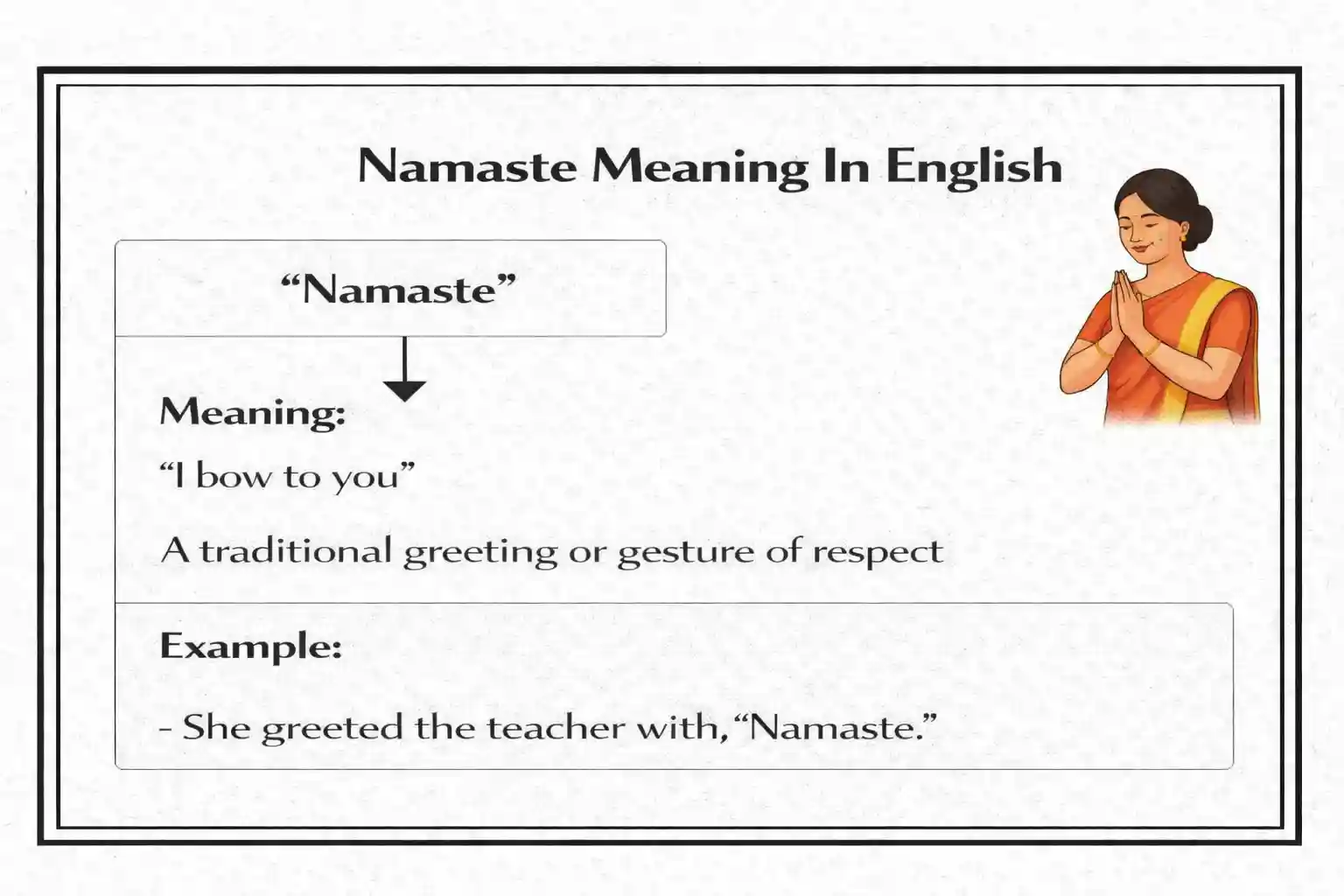
Namaste basically means “I bow to you.”
In everyday life, you can understand Namaste Meaning in English as:
“I greet you with respect.”
You can think of it like a polite, warm hello that also shows respect.
Where Does the Word “Namaste” Come From?
The word namaste comes from Sanskrit.
Sanskrit is an old language from India.
The word has two parts:
- “nama” or “namah” – this means bow or respect
- “te” – this means to you
Put together:
nama + te = namaste → “I bow to you.”
So the most basic Namaste Meaning in English is:
“I bow to you.”
This “bow” is not always a big deep bow like in some cultures.
It is more like:
“I lower myself a little in respect to you.”
How Do People Say “Namaste” – The Gesture
When people say namaste, they often do a special gesture.
This is a big part of the feeling.
Here is what they do:
- They join their hands together in front of their chest.
- The palms touch. Fingers point up.
- They bow their head slightly.
- They say, softly: “Namaste.”
This hand position has a fancy name in yoga (añjali mudra),
but you don’t need to remember that.
In simple words, it is:
hands together + small bow + “namaste”
This shows:
- respect
- peace
- humility
- friendliness
So the full Namaste Meaning in English is not just the sound of the word.
It is also:
“I greet you with my hands joined and my head bowed in respect.”
How Namaste Is Used in Daily Life (India and Nearby Countries)
In India and some other South Asian countries, namaste is very common.
It is not only used in yoga classes.
It is part of normal life.
Here are some simple scenes so you can feel it.
Greeting elders
A boy sees his grandmother.
He joins his hands and says:
“Namaste, Dadi.”
(Dadi means grandma.)
She smiles and replies:
“Namaste, beta.”
(Beta means child/son/daughter in a loving way.)
Here, the Namaste Meaning in English is like:
- “Hello, Grandma, I respect you.”
- “Hello, my child, I love you.”
Greeting guests
A guest comes to visit a family.
The host opens the door, joins hands, and says:
“Namaste, please come in.”
The guest answers:
“Namaste, thank you.”
Here, namaste means:
- “Welcome, I am happy you are here.”
- “Hello, thank you for having me.”
In shops or offices
A shopkeeper might say:
“Namaste ji, how can I help you?”
The customer might reply:
“Namaste, I need some vegetables.”
“Ji” is a polite word.
In this situation, namaste is like:
- “Good day, sir/madam.”
- “Hello, I greet you politely.”
So in daily life, the Namaste Meaning in English is often:
“Hello, with respect.”
It can also work as a polite goodbye when someone is leaving.
Namaste in Yoga Classes
In many other countries, people first hear namaste in yoga class.
At the end of the class, the teacher often says:
“Bring your hands to your heart.
Bow your head.
Namaste.”
The students then say:
“Namaste.”
In this moment, the Namaste Meaning in English is a little deeper.
It often carries these feelings:
- “Thank you for practicing with me.”
- “I respect you.”
- “We shared this time and this energy together.”
Some yoga teachers explain namaste in English like this:
“The light in me honors the light in you.”
“The soul in me greets the soul in you.”
“The divine in me bows to the divine in you.”
These are not word-for-word translations.
They are nice spiritual explanations.
So in yoga:
- namaste can mean hello
- namaste can mean thank you
- namaste can mean I honor you
All at the same time.
Social Meaning vs Spiritual Meaning
Now it becomes easier to understand why people search Namaste Meaning in English so much.
Sometimes namaste sounds simple.
Sometimes it sounds very spiritual.
The truth is:
Both uses exist.
Social use
In many homes in India:
- A child says namaste to a teacher.
- A neighbor says namaste to another neighbor.
- A worker says namaste to a customer.
They are not always thinking about God or the soul.
They are mostly thinking:
“Hello, I greet you respectfully.”
So in social life, namaste is just:
polite hello / polite goodbye.
Spiritual use
In yoga, temples, meditation halls, or spiritual groups, namaste can be used with more inner meaning.
In those places, namaste can mean:
- “I see the divine part in you.”
- “We are connected beyond our bodies.”
- “I bow to your inner light.”
So you can say:
In normal life, namaste is respectful greeting.
In spiritual life, namaste can be heart-to-heart greeting.
In both cases, it is never rude.
It always has a feeling of respect.
Is Namaste a Religious Word?
People often worry about this when they ask about Namaste Meaning in English.
Here is a simple answer:
- Namaste comes from a culture where religions like Hinduism, Buddhism, Jainism, etc. exist.
- It is sometimes used in religious or spiritual places.
- But it is also used in normal daily life by people of many beliefs.
So:
- It can have a spiritual feeling.
- But it does not have to be a religious act every time.
A person can say namaste and simply mean:
“Hello, I respect you,”
without thinking of any religion.
How to Say Namaste (Pronunciation and Tone)
If you want to say namaste yourself, here is an easy way to say it.
Pronounce it like:
“nuh-MUH-stay”
or
“nah-mah-stay”
Both are fine.
Most people will understand you.
Tips for saying it:
- Say it a little slowly.
- Keep your voice soft.
- Don’t shout it like a joke.
- Let it sound warm and calm.
You can add the hand gesture if it feels right:
- Join your hands
- Bow your head a little
- Say “Namaste”
How to Reply When Someone Says “Namaste”
If someone says “Namaste” to you, you can simply answer:
“Namaste.”
That is enough.
You can:
- just say the word
- or say the word and join your hands
- or say the word and smile
There is no long expected reply.
Just returning namaste with namaste is polite and correct.
In English meaning, you are saying:
“I greet you and respect you too.”
When Is It Okay for You to Say Namaste?
If you are not from India, you might ask:
“Is it okay for me to say namaste?”
In general:
- Yes, it is okay.
- People usually appreciate it if you say namaste with respect.
Good times to say namaste:
- At the end of a yoga class
- When an Indian person greets you with namaste first
- When you visit an Indian home and others are using the word
- At a cultural or spiritual event where namaste is normal
The important thing is your intention.
If you say namaste to honor someone, it is usually welcome.
If you say it as a joke or to mock, it is hurtful.
When You Should Be Careful Using Namaste
You may want to avoid using namaste in these ways:
- as a silly joke in a fake accent
- as a word printed on items only to look “exotic” without any respect
- in places where a simple “hello” is more clear and natural (for example, a formal email to your Western boss)
Namaste is tied to real people and real history.
Using it lightly, with no care, can feel wrong.
Using it with a kind and honest heart feels right.
Simple English Ways to Explain Namaste
If someone asks you:
“What is the Namaste Meaning in English?”
you can answer in simple ways like:
- “Namaste means I bow to you.”
- “It’s like hello, but more respectful.”
- “It is a polite greeting used in India and yoga.”
- “It means I greet you and I respect you.”
- “In yoga, it can also mean the light in me honors the light in you.”
All of these are good and easy.
Small Dialogues Using Namaste
Here are some tiny dialogues you can imagine or use.
Dialogue 1 – Yoga
Teacher:
“Thank you for practicing today. Namaste.”
Students:
“Namaste.”
English feeling:
“Thank you, I respect you.”
“Thank you, we respect you too.”
Dialogue 2 – Home
Child:
“Namaste, Mummy. I’m home.”
Mother:
“Namaste, beta. How was your day?”
English feeling:
“Hello, Mom.”
“Hello, my child.”
Dialogue 3 – Meeting someone new
You meet an Indian family friend.
You join your hands a bit and say:
“Namaste, nice to meet you.”
They reply:
“Namaste, nice to meet you too.”
English feeling:
- “Hello, with respect, nice to meet you.”
Simple Table for Namaste Meaning in Different Moments
Here’s an easy table so you can quickly see Namaste Meaning in English in different situations.
| Where / When | What “Namaste” Means in Easy English |
|---|---|
| At home with family | Hello / Goodbye with love and respect |
| Meeting elders | Respectful hello |
| In shops or offices | Polite greeting (like “good day”) |
| At the end of yoga class | Thank you, I respect you, goodbye |
| In a temple or spiritual event | I bow to you, I honor your inner self |
| Online message | Warm, respectful hello |
In all cases, the center idea stays the same:
Namaste = greeting with respect.
Namaste vs “Hello,” “Goodbye,” and “Thank You”
It can help to compare namaste with common English words.
Namaste vs Hello
- Hello – basic greeting, any time, any person
- Namaste – greeting with extra respect, often softer and calmer
So namaste is like:
“Hello, I respect you.”
Namaste vs Goodbye
- Goodbye – what you say when leaving
- Namaste – can be said both when you meet and when you leave
So namaste can work like:
hello and goodbye, but with honor.
Namaste vs Thank You
- Thank you – clearly about gratitude
- Namaste – sometimes carries thanks, especially in yoga or after a shared moment
In many yoga classes, namaste feels almost like:
“Thank you very much, from my heart.”
But strictly speaking, it still means “I bow to you.”
How Namaste Shows Respect Without Touch
One special thing about namaste is that you do not need to touch the other person.
You do not:
- shake hands
- hug
- kiss on the cheek
You simply:
- stand at a small distance
- join your hands
- bow your head
- say “Namaste”
This can be very useful when:
- people want to keep some distance
- someone is sick
- there are health concerns
- two people from different cultures feel shy about touching
So another part of Namaste Meaning in English is:
“I greet you with respect, and I also respect your space.”
Final Summary of Namaste Meaning in English
Let’s put everything together in a short, clear list.
- Namaste is a greeting used in India and many other places.
- It comes from Sanskrit and is formed from “nama” (bow) + “te” (to you).
- The most basic Namaste Meaning in English is: “I bow to you.”
- In daily life, it is used like:
- hello with respect
- sometimes goodbye with respect
- In yoga and spiritual places, it can also feel like:
- thank you
- I honor the light or soul in you
- It is usually said with:
- hands joined in front of the chest
- a small bow of the head
- It is not only a religious word.
It can be social or spiritual, depending on the person and place. - Anyone can say namaste if they say it:
- kindly
- softly
- with real respect
So when you say:
“Namaste.”
In simple English, you are really saying:
“I greet you. I respect you. I bow to you.”
And now you fully understand the Namaste Meaning in English in clear, easy language.

About Grayson
Grayson is a professional English language teacher and the founder of WordEncyclo. With years of teaching experience, he specializes in vocabulary development, etymology, and word usage. His mission is to make English words and their meanings accessible to learners at all levels through clear, accurate, and well-researched content.