
You are here because you saw or wrote something like this:
- “He has a deep seeded fear of failure.”
- “She has a deep seated fear of failure.”
And now you’re thinking:
“Deep Seeded Or Seated – which one is correct?”
“Why do people use both?”
“What should I use in my writing?”
This guide will explain everything in simple English, step by step.
No hard grammar words. No confusing terms. Just clear meaning, lots of examples, and a full answer to Deep Seeded Or Seated.
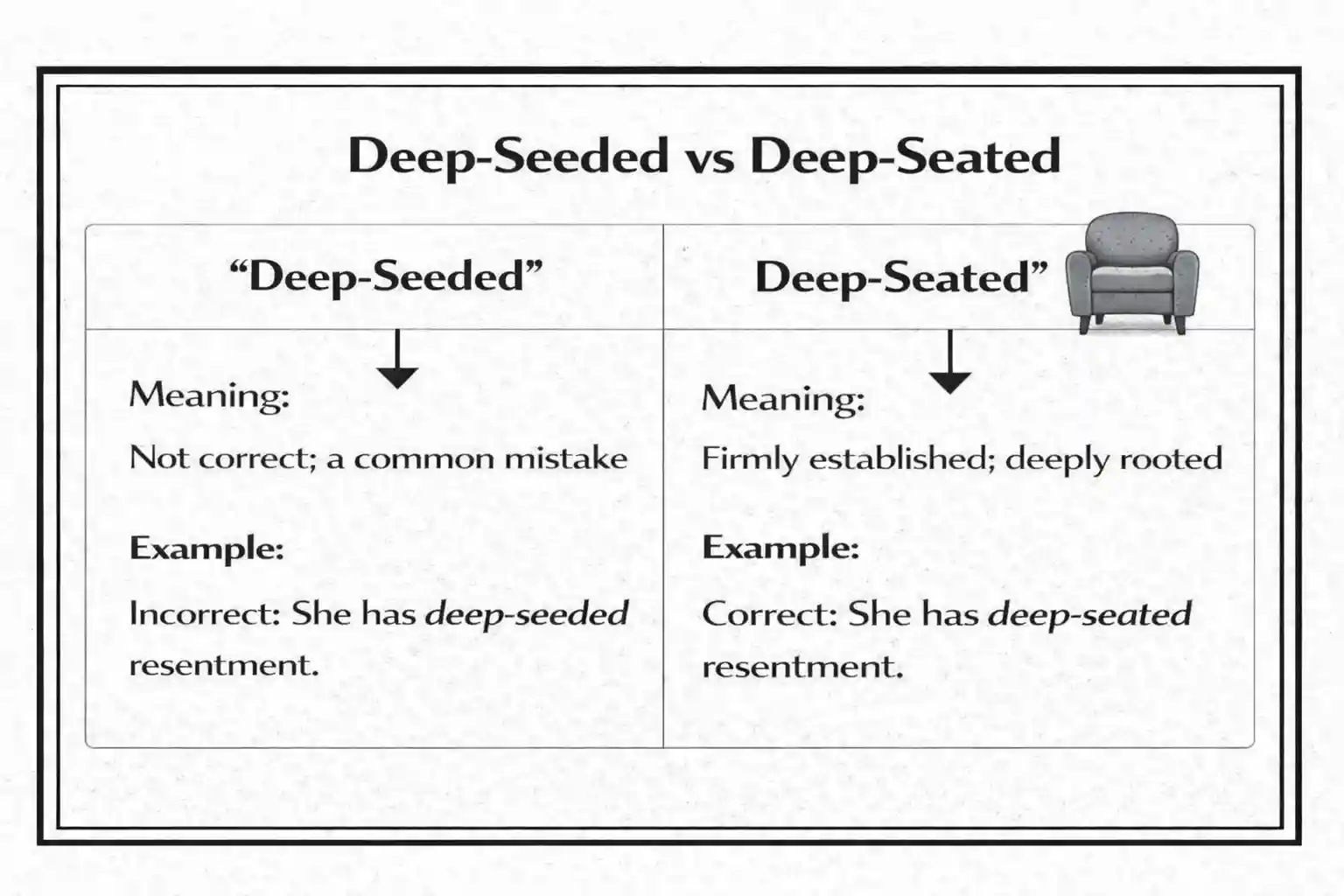
Quick Answer: Deep Seeded Or Seated?
Let’s start with the short answer before we go into details.
- ✅ Correct: deep-seated (or “deep seated”)
- ❌ Common mistake: deep-seeded (or “deep seeded”)
So when you have to choose:
Deep Seeded Or Seated?
The correct English phrase is deep-seated.
You can write:
- deep-seated fear
- deep-seated belief
- deep-seated problem
Some people leave out the dash and write deep seated. That is also okay.
But the important part is:
“seated” is right, “seeded” is wrong.
What Does “Deep-Seated” Mean?
Now let’s focus on the meaning of deep-seated.
Simple meaning
Deep-seated means:
Something is very strong, very fixed, and hard to change.
It is not just a light feeling.
It is not just a short idea.
It is something that is stuck deep inside.
We often use deep-seated with:
- fear
- belief
- anger
- mistrust
- habits
- problems
- love
- hope
Easy examples
- “He has a deep-seated fear of flying.”
→ His fear is strong and has been there for a long time. - “She has a deep-seated belief in hard work.”
→ This belief is deep in her mind and part of who she is. - “There is deep-seated anger in the group.”
→ The anger is not new. It has been there a long time. - “The country has deep-seated problems with corruption.”
→ The problems are serious and not easy to fix.
So when you see deep-seated, think:
“This thing is deep, strong, and not easy to change.”
That is the heart of the phrase behind Deep Seeded Or Seated.
Why “Seated” And Not “Seeded”?
This is the key to understanding Deep Seeded Or Seated.
“Seated” – connected to “seat”
The word seated comes from seat.
A seat is a place where you sit.
- If you are seated, you are sitting down somewhere.
- If something is deep-seated, it is like it is sitting deep inside you.
You can think of it like this:
A deep-seated fear sits deep in your mind or heart.
A deep-seated belief sits deep in your thoughts.
It has a “seat” inside you.
It does not move easily.
“Seeded” – connected to “seed”
The word seeded comes from seed.
- Seeds go into the ground.
- You use seeds to grow plants.
- To “seed” something is to put seeds there.
So deep-seeded sounds like something was planted deep with seeds.
It might sound pretty, and it might feel “logical” in your head:
- “My fear is like a seed deep inside me.”
But this is not the original phrase.
The real phrase is about where something sits (its “seat”), not about where a seed is planted.
That’s why in Deep Seeded Or Seated, the correct choice is deep-seated.
Why Do So Many People Say “Deep-Seeded”?
If deep-seated is correct, why does “deep-seeded” show up everywhere?
There are a few simple reasons.
1. They sound almost the same
Say them out loud:
- deep-seated
- deep-seeded
In fast speech, they sound very close.
Many people don’t clearly hear the “t” sound in seated.
So when they go to write the phrase, they think of seed, and they write deep-seeded.
2. The “seed” picture feels right
People often think:
- “Beliefs start small, like seeds.”
- “Fear can grow from a small seed inside us.”
So “deep-seeded fear” sounds like:
“Fear that was seeded deep inside me.”
This picture feels nice and poetic.
So people think it must be correct.
But it is still not the standard phrase.
In good English, the fixed, accepted phrase is deep-seated.
3. People copy what they see online
On social media, blogs, comments, and casual posts, many people type deep-seeded.
Other people see it and think:
“Okay, that must be how you spell it.”
So the error spreads.
But if you want to write correct English in:
- school work
- articles
- professional writing
- serious blog posts
then you should always write:
✅ deep-seated (not deep-seeded)
Deep Seeded Or Seated – Clear Comparison
Here is a simple table to sum up Deep Seeded Or Seated:
| Phrase | Correct? | Simple meaning |
|---|---|---|
| deep-seated | ✅ Yes | Strong, fixed, deep inside, hard to change |
| deep seated | ✅ Yes | Same as deep-seated, just without the dash |
| deep-seeded | ❌ No | Common error; sounds like “seed planted deep” |
| deep seeded | ❌ No | Same wrong form without the dash |
So, if you are ever unsure and thinking:
“Should I write Deep Seeded Or Seated?”
Remember:
The correct phrase is deep-seated.
Many Simple Examples With “Deep-Seated”
To make “deep-seated” feel natural, let’s put it into many everyday sentences.
Deep-seated fear
- “She has a deep-seated fear of dogs after being bitten as a child.”
- “He has a deep-seated fear of flying and avoids planes.”
- “Some people have deep-seated fears they never talk about.”
Deep-seated belief
- “Her deep-seated belief in honesty guides her actions.”
- “They share a deep-seated belief that family comes first.”
- “There is a deep-seated belief in the town that change is risky.”
Deep-seated anger
- “He carries deep-seated anger from his past.”
- “There is deep-seated anger between the two groups.”
- “Years of unfair treatment created deep-seated anger in the staff.”
Deep-seated problems
- “The company has deep-seated problems with communication.”
- “There are deep-seated problems in the education system.”
- “This is not a small issue; it is a deep-seated problem.”
Deep-seated habits
- “His deep-seated habit of interrupting others makes people upset.”
- “She has deep-seated habits from childhood that are hard to break.”
- “The team’s deep-seated habit of poor planning leads to late projects.”
Deep-seated love / hope / trust
Deep-seated does not have to be negative. It can also be used for good things.
- “She has deep-seated love for her children.”
- “He has deep-seated hope that things will get better.”
- “There is deep-seated trust between the two friends.”
In every example, deep-seated means:
- not new
- not light
- very strong
- stuck deep inside
Wrong vs Right: Fixing “Deep Seeded Or Seated” Sentences
Let’s look at some wrong sentences using deep-seeded and fix them.
| Wrong sentence | Fixed sentence |
|---|---|
| “He has a deep-seeded fear of snakes.” | “He has a deep-seated fear of snakes.” |
| “Her deep seeded beliefs are strange.” | “Her deep-seated beliefs are strange.” |
| “The issue is deep seeded in our culture.” | “The issue is deep-seated in our culture.” |
| “There is deep seeded hate in that town.” | “There is deep-seated hate in that town.” |
| “This is a deep seeded conflict.” | “This is a deep-seated conflict.” |
When you fix deep seeded or seated to deep-seated, the meaning becomes correct in standard English.
Memory Tricks To Remember “Deep-Seated”
Here are some very easy ways to remember the right side in Deep Seeded Or Seated.
Trick 1: Seat = chair
Think of a seat, like a chair.
- If something is seated, it is sitting.
- A deep-seated fear is like a fear sitting deep inside you.
So:
Seat → seated → deep-seated
Trick 2: Ask “Is this about plants?”
Seeds belong in:
- soil
- gardens
- farms
But deep-seated fear, deep-seated belief, deep-seated anger are not about plants.
So ask yourself:
“Am I talking about soil and plants?”
If the answer is no, then:
You want seated, not seeded.
Trick 3: Replace with “strong and fixed”
Try replacing the phrase with “strong and fixed”:
- “She has a deep-seated fear of storms.”
→ “She has a strong and fixed fear of storms.” ✅ Makes sense.
But if you try to think “deep-seeded fear,” it doesn’t match that test so well.
This can help you remember that deep-seated is the right expression.
Deep-Seated In Different Types Of Writing
Understanding Deep Seeded Or Seated also matters in different areas of writing.
In school essays
Teachers and exam markers expect the correct form.
Good examples for school:
- “The main character struggles with deep-seated guilt.”
- “The story shows deep-seated prejudice in the town.”
If you write “deep-seeded prejudice,” it may be marked wrong.
In work and business
In emails, reports, or presentations, you might write:
- “The team has deep-seated issues with trust.”
- “We must address the deep-seated problems in our process.”
Here, using deep-seated shows you pay attention to your words and know correct forms.
In articles and blogs
If you are writing online:
- a blog post
- a long guide
- a helpful explainer
using deep-seated instead of “deep-seeded” will make your writing look more professional and careful.
Other Phrases Similar To “Deep-Seated”
You might not want to repeat the same phrase too many times.
Here are some other simple phrases with a similar idea to deep-seated:
| Phrase | Simple meaning |
|---|---|
| deep-rooted | very deep and strong |
| deeply rooted | very strong and built over time |
| strongly rooted | strong and fixed |
| long-standing | has existed for a long time |
| firmly fixed | not easy to change |
| ingrained | built into habits or thinking |
Examples:
- “They have deep-rooted beliefs about family.”
- “The problem is long-standing and hard to solve.”
- “She has ingrained habits from childhood.”
These phrases carry the same idea as deep-seated:
something is deep, strong, and hard to change.
Practice: Choose Deep Seeded Or Seated
Let’s do a short practice.
For each sentence, choose the correct form: deep-seated.
- “She has a ________ fear of being alone.”
- “The city has ________ problems with poverty.”
- “There is ________ mistrust between the two groups.”
- “He has ________ beliefs that he learned as a child.”
- “They feel ________ anger because of years of unfair treatment.”
Answers:
- deep-seated fear
- deep-seated problems
- deep-seated mistrust
- deep-seated beliefs
- deep-seated anger
Every correct answer is deep-seated, not deep-seeded.
This is why, in the Deep Seeded Or Seated question, deep-seated always wins.
FAQ About “Deep Seeded Or Seated”
A: The correct phrase is deep-seated. “Deep-seeded” is a very common mistake.
A: It means very strong, very deep, and hard to change. Often used for fears, beliefs, habits, and problems.
A: Because “deep-seated” and “deep-seeded” sound very similar when spoken. Also, the idea of a seed “deep inside” feels natural, so people guess the spelling wrong.
A: In careful English (school, work, serious writing), yes, it is treated as wrong. In casual conversation, people may use it, but it is still not the proper form.
A: You can write deep-seated (with a dash) or deep seated (without). Many writers use the dash when the phrase comes before a noun: “deep-seated fear.”
A: Yes. You can say “deep-seated love,” “deep-seated hope,” “deep-seated trust.” It still means strong and deep.
Final Simple Summary: Deep Seeded Or Seated?
Let’s bring everything into one easy summary.
When you see or think Deep Seeded Or Seated, remember:
- The correct phrase is deep-seated.
- It means strong, deep, and hard to change.
- We use it with fears, beliefs, habits, feelings, problems, and more.
- Deep-seeded looks and sounds close, but it is a mistake in standard English.
So instead of writing:
“She has a deep seeded fear of failure.”
you should write:
“She has a deep-seated fear of failure.”
And now, when anyone asks “Deep Seeded Or Seated?”,
you can confidently say:
“The correct phrase is deep-seated – always.”

About Grayson
Grayson is a professional English language teacher and the founder of WordEncyclo. With years of teaching experience, he specializes in vocabulary development, etymology, and word usage. His mission is to make English words and their meanings accessible to learners at all levels through clear, accurate, and well-researched content.