
You type a message, stop, and stare at the screen:
“Should I write segue into the next topic… or segway into it?”
Both sound the same. One looks like the scooter brand. One looks like a typo. English is doing its usual thing: confusing everyone.
This guide will walk through segue vs segway in simple language, with clear examples, tables, and little tricks so you never doubt yourself again.
Segue Vs Segway Meaning
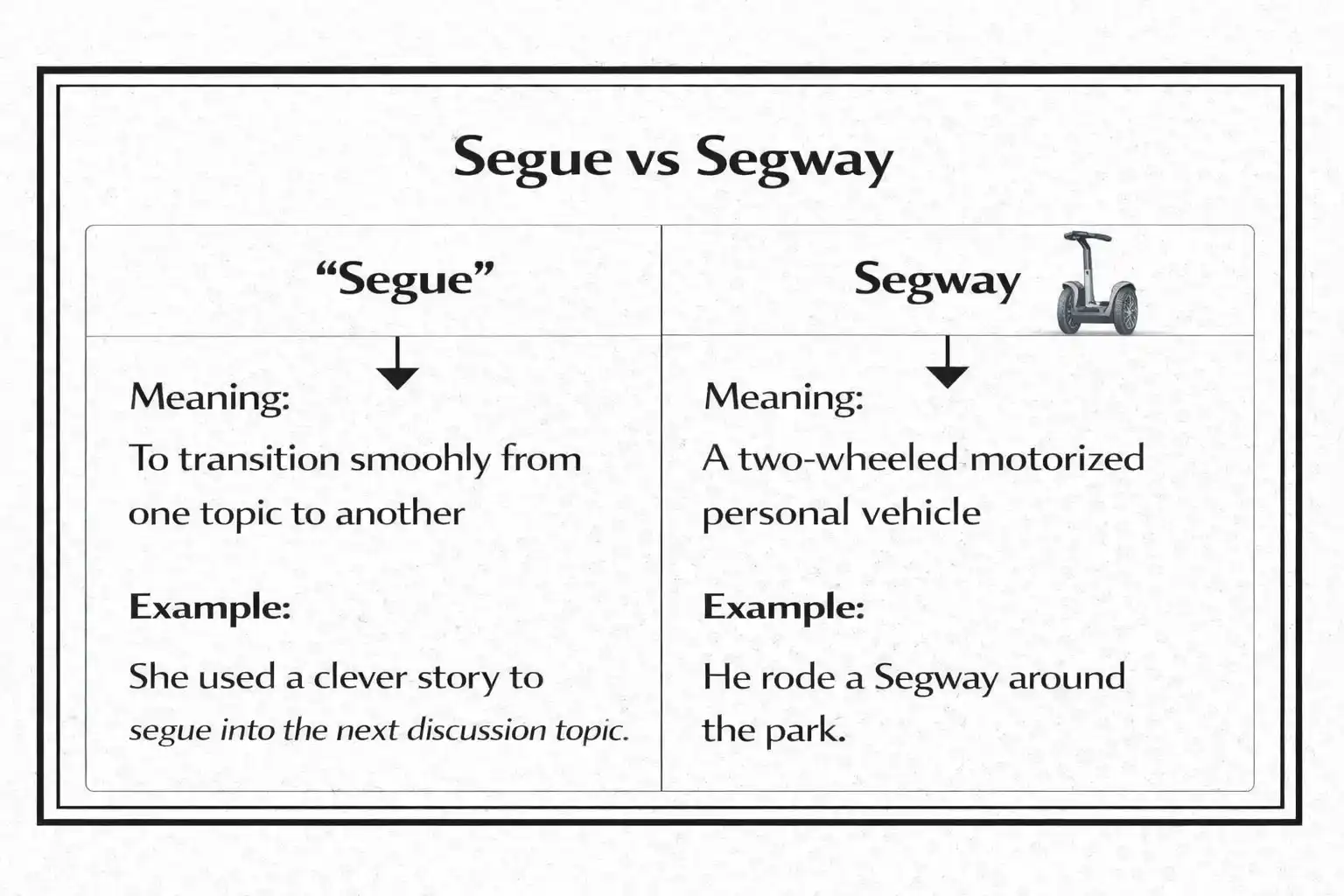
Let’s start with the basic Segue vs segway meaning in plain words.
What “Segue” Means
Segue is a word that means:
to move smoothly from one topic, idea, scene, or piece of music to another.
You’ll see segue:
- in conversations
- in emails and reports
- in podcasts and videos
- in movies, TV, and music
It can be a verb or a noun.
- Verb: “to segue into something”
- Noun: “a smooth segue”
Examples:
- “Let me segue into our next point.”
- “That story was a perfect segue to the main topic.”
- “The movie segues from the past to the present.”
What “Segway” Means
Segway is a brand name.
It usually means the standing two-wheeled electric scooter you see:
- on city tours
- with security guards in malls or airports
- on big campuses
Examples:
- “We booked a Segway tour around the city.”
- “The security guard rode past on a Segway.”
- “He almost fell off his Segway on the hill.”
If you’re talking about ideas changing, the word you want is segue, not segway.
Quick Comparison Table
| Feature | Segue | Segway |
|---|---|---|
| Basic meaning | Smooth transition | Electric scooter / brand name |
| Type of word | Common word (noun / verb) | Proper noun (brand) |
| Capital letter | Usually lowercase: segue | Often capitalized: Segway |
| Used in | Conversation, writing, music, media | Transportation, tours, security |
| Common mistake | Spelled as “segway” | Used when people really mean “segue” |
Segway Or Segue Pronunciation
Now the fun part: Segway or segue pronunciation.
They are pronounced exactly the same in American English:
SEG-way
- First part: SEG (like the start of “segment”)
- Second part: way (like “go that way”)
Pronunciation Table
| Word | Spelling | Pronunciation | Sounds Like |
|---|---|---|---|
| segue | s-e-g-u-e | SEG-way | Segway |
| Segway | S-e-g-w-a-y | SEG-way | Segway |
So the question is not how to say them.
The real problem is: which spelling fits what you’re trying to say?
- Talking about changing topics? → segue
- Talking about the scooter? → Segway
Segue Vs Segway Examples
Seeing a lot of Segue vs segway examples in context makes the difference much easier to remember.
Everyday Conversation Examples
Correct:
- “Speaking of travel, that segues into my next question.”
- “Her joke actually segues into something serious.”
- “That story was a great segue into the main topic.”
Incorrect (but common online):
- “Speaking of travel, that segways into my next question.” ❌
- “Nice segway into that topic.” ❌ (should be segue)
Work And Email Examples
Correct:
- “Let me segue into the results from last month.”
- “This naturally segues into a discussion about cost.”
- “That brings us to a perfect segue into our next section.”
Incorrect:
- “Let me segway into the results…” ❌
- “This is a great segway into pricing.” ❌
Writing And Content Examples
Correct:
- “The author uses a clever segue between the two chapters.”
- “Your essay needs a smoother segue from the intro to the body.”
- “The podcast segues from news into an interview.”
Scooter Examples (Real Segways)
Correct:
- “We went on a Segway tour in San Francisco.”
- “He drives a Segway around the campus.”
- “They rent Segways near the beach.”
Here, if you change the word to segue, the sentence stops making sense.
What Is A Segway In A Conversation?
You might see people ask:
“What is a segway in a conversation?”
Technically, in a conversation, you don’t want the scooter at all.
You want the transition. That word is segue.
So if someone says:
- “That was a good segway into your main point.”
What they really mean is:
- “That was a good segue into your main point.”
In conversation, a segue is:
- a smooth change from one topic to another
- a way to keep the flow natural
- a bridge that connects ideas
Examples:
- “Talking about weekends segues into my question about your trip.”
- “On that note, let me segue into our next topic.”
- “Her comment about stress segues into the subject of work-life balance.”
So if you’re asking What is a segway in a conversation?
The correct phrase is really:
What is a segue in a conversation?
Answer: A smooth, natural transition between topics.
Nice Segway Meaning
Online, you’ll often see people type:
- “Nice segway.”
- “That was a weird segway.”
- “Nice segway into your ad.”
Let’s unpack the Nice segway meaning.
Most of the time, “Nice segway” actually means:
“Nice segue” = nice, smooth transition.
People are hearing the sound SEG-way and spelling it like the scooter.
When It’s A Compliment
Used seriously:
- “Nice segue from the intro to the main point.”
- “That was a really smooth segue into the serious part.”
Here, the person is praising how natural the topic change was.
When It’s Sarcastic
Used jokingly or with an eye-roll:
- “Nice segue… totally not random at all.”
- “Nice segue from pizza to politics.”
In both cases, the correct spelling is still segue, not segway.
Quick Table: “Nice Segue” Vs “Nice Segway”
| Context | Correct Phrase | What It Means |
|---|---|---|
| Compliment on a transition | “Nice segue.” | The topic change was smooth and natural. |
| Sarcastic joke about a jump | “Nice segue.” | The topic change was sudden or awkward. |
| Talking about the scooter | “Nice Segway.” | You like the actual scooter. |
Most of the time online, people mean segue, not the scooter.
Segue Way In A Sentence
Many people search for “Segue way in a sentence” because they’re not sure how to spell it or how to use it.
The good news: it’s simpler than it looks.
Correct Spelling
- Always write segue as one word.
- Not “segue way”
- Not “seg-way”
- Not “segwey”
Just: segue
Common Sentence Patterns
Most often, segue appears in these forms:
- segue into + topic
- “Let me segue into the next point.”
- “This segues into our final topic.”
- as a noun, after an adjective
- “That was a smooth segue.”
- “We need a better segue between these sections.”
More Examples: Segue In A Sentence
- “Her funny story segues into a serious message.”
- “This statistic provides a natural segue into the budget discussion.”
- “He used a joke as a segue into his main argument.”
- “The song segues directly into the live version of the track.”
If you ever catch yourself typing “segue way,” stop and change it to segue.
Segway Transition: Why It Sounds Right But Looks Wrong
The phrase “Segway transition” shows up a lot, especially in casual posts or comments.
For example:
- “That was a perfect segway transition.”
- “Use a segway transition to move between topics.”
People choose segway transition because:
- It sounds like “segue”
- A Segway literally moves you from place to place
- Their brain links the idea of movement with change
But in normal, careful English:
- If you’re talking about ideas or topics, it’s a segue, not a segway.
- So the phrase should be “smooth segue” or “segue into”, not “segway transition.”
The only time segway transition really makes sense is if:
- someone is actually using a Segway scooter as part of a visual or video transition.
For example:
- “The video uses a Segway transition where the host rides in on a Segway between scenes.”
That’s rare.
In regular writing, just use segue.
What People Say Online: Segue Vs Segway Reddit
If you read a Segue vs segway reddit thread, you’ll usually see three types of comments:
- “It should be fine to use segway for transition.”
These people argue that language changes and “segway” looks more logical. - “No, segue is the correct word.”
These people point out that Segway is a brand and segue is the real word for a transition. - “I just want to not look dumb in emails.”
Most people simply want the correct spelling when they write something important.
For real-life use, especially in the US:
- In work emails, school papers, and public posts, always write segue for transitions.
- If you type “segway” for a topic change, many readers will see it as a spelling mistake.
How To Use “Segue” Correctly (Step By Step)
Let’s break down how to use segue so you can drop it into sentences without thinking.
1. As A Verb
Pattern: segue into + topic
Examples:
- “Let me segue into our last point.”
- “This naturally segues into the question of cost.”
- “We’ll segue into Q&A after this slide.”
Tenses:
- Present: “I segue,” “it segues”
- Past: “it segued into”
- -ing form: “segueing into” (often used, even if it looks odd)
2. As A Noun
Examples:
- “That was a smooth segue.”
- “You need a better segue between these two ideas.”
- “The song has a long segue into the final track.”
If “transition” fits in your sentence, chances are segue works too.
Memory Tricks So You Never Forget
Here are a few simple tricks to keep segue and Segway separate in your head.
Trick 1: Segue And Segment
Both segue and segment start with seg-.
A segue moves you between segments of a talk, video, or text.
- segue → segment
Think: “A segue connects segments.”
Trick 2: Segway Has “Way”
Segway has the word “way” in it.
- Segway → the “way” you travel on wheels.
So if you picture a road or path, that’s the scooter brand.
Trick 3: Picture The Scene
Ask yourself:
- Is someone riding something? → think Segway
- Is someone changing topics or ideas? → think segue
That quick mental check keeps your spelling clean.
Mini Quiz
Test yourself with a few quick ones. Fill in segue or Segway.
- “Let me ___ into the final topic.”
- “We booked a ___ tour of the city.”
- “That joke was a perfect ___ into your main point.”
- “The security guard uses a ___ at the mall.”
- “This statistic ___s into a discussion about pricing.”
Answers:
- segue
- Segway
- segue
- Segway
- segue
Short FAQ On Segue Vs Segway
Yes, but only for the scooter or brand:
“He rode a Segway.”
“We went on a Segway tour.”
If you are talking about changing topics, “segway” is a spelling mistake.
Use segue.
Usually yes, because it’s a brand name.
In casual online writing, people sometimes use lowercase, but Segway is the proper form.
The plural is segues.
“The show had several clever segues between segments.”
No. That’s just mixing both together.
Use segue by itself.
Final Recap
Let’s pull everything together in one place.
- Segue = smooth transition between ideas, topics, scenes, or songs.
- Segway = electric scooter brand.
They share the same SEG-way pronunciation, but they are not the same word.
If you’re writing for work, school, or any serious setting in the USA and you mean a transition, always choose:
segue
And if you ever see someone write “Nice segway” when they praise a smooth topic change, you’ll quietly know:
That’s actually “Nice segue.”

About Grayson
Grayson is a professional English language teacher and the founder of WordEncyclo. With years of teaching experience, he specializes in vocabulary development, etymology, and word usage. His mission is to make English words and their meanings accessible to learners at all levels through clear, accurate, and well-researched content.