
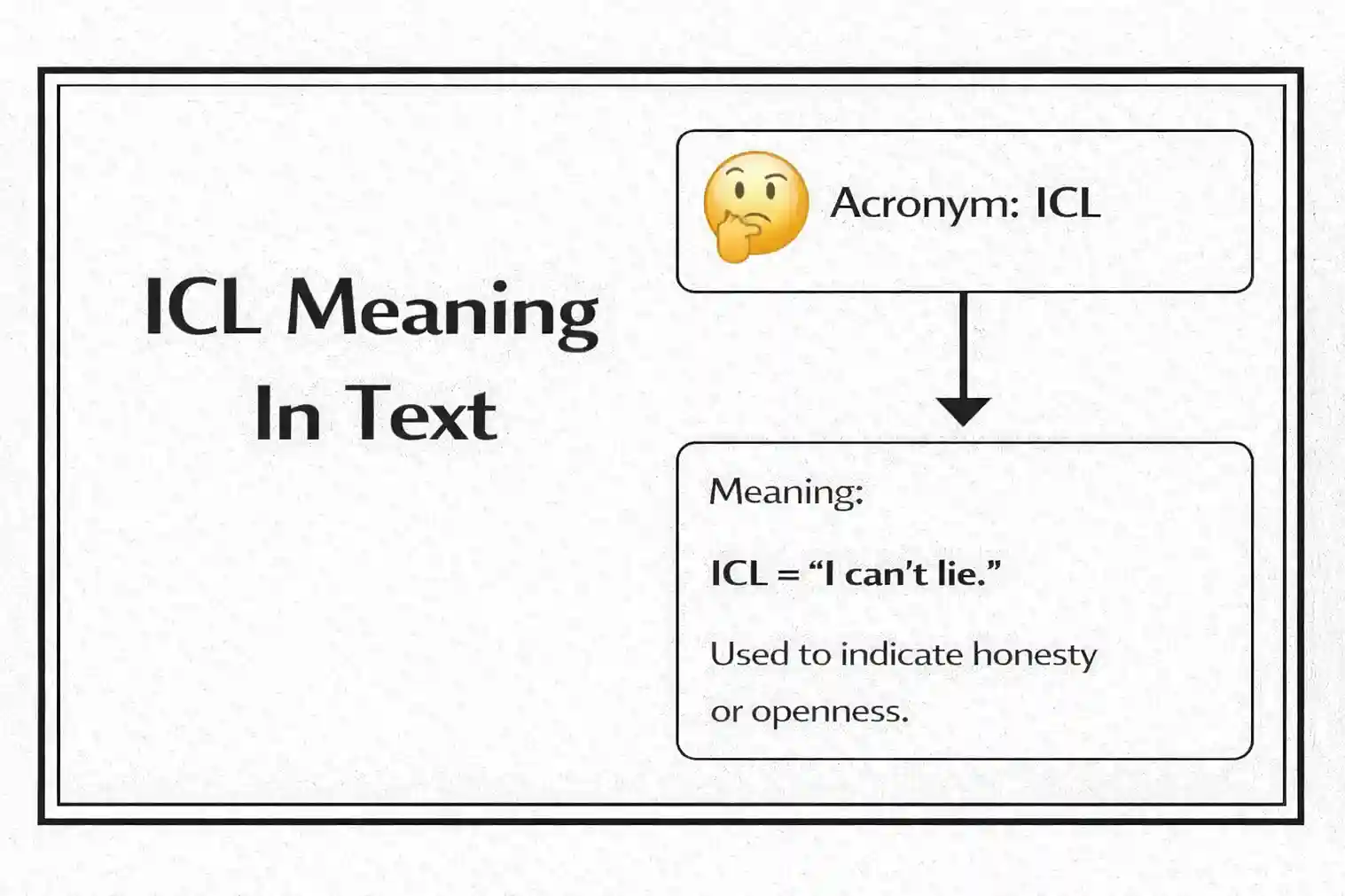
Three little letters – ICL – show up everywhere now:
- TikTok comments
- Snapchat stories
- private DMs
- group chats
People drop lines like:
- “ICL, that movie was mid.”
- “ICL you’re kind of right.”
- “ICL this outfit goes hard.”
If you’re searching “icl meaning” or “icl meaning in text”, you’re trying to decode that tone without guessing. Let’s walk through what it means, how people actually use it, and what else it can stand for.
Core ICL meaning in chat and slang
In modern internet slang, especially with Gen Z, ICL most commonly means:
“I can’t lie.”
It’s a short way to say:
- “Honestly…”
- “To be real…”
- “I’m telling you the truth here.”
People often use ICL:
- at the start of a sentence
- sometimes in the middle or at the end
- to frame what they’re about to say as honest or unfiltered
It’s similar in feeling to:
- NGL – not gonna lie
- TBH – to be honest
- no cap – I’m not lying / no exaggeration
Here’s a quick comparison:
| Slang | Long form | Simple idea | Example |
|---|---|---|---|
| ICL | I can’t lie | I’m being honest | “ICL, that song grew on me.” |
| NGL | Not gonna lie | Same as ICL, very close | “NGL, I was nervous.” |
| TBH | To be honest | Honest opinion | “TBH, I don’t like that plan.” |
| no cap | – | No lie / not exaggerating | “This food is amazing, no cap.” |
So when you see ICL in chat, read it as a small honesty warning:
“What I’m saying now is the real truth, not sugar-coated.”
How people actually use ICL in messages
Because icl meaning is tied to honesty, it shows up in a few typical ways.
Sharing a blunt opinion
People use ICL before saying something that might be a bit harsh, bold, or surprising.
- “ICL, that show fell off after season 2.”
- “ICL, I don’t vibe with that friend group.”
- “ICL, the old version was better.”
Here, ICL prepares the reader:
“I’m about to be real, don’t be shocked.”
Softening criticism (a little)
Sometimes ICL is used to make a negative comment feel slightly less aggressive, like “I’m not trying to be mean, just honest.”
- “ICL, you could’ve handled that better.”
- “ICL, those shoes don’t match the outfit.”
- “ICL, your text sounded a bit dry.”
It doesn’t remove the criticism, but it frames it as truthful, not random hate.
Emphasising something positive
ICL isn’t only for negative takes. People also use it when hyping something up.
- “ICL, you’ve been doing great lately.”
- “ICL, that haircut suits you so much.”
- “ICL, this is one of your best posts.”
Same meaning:
“I’m really not lying, I mean this.”
Admitting something
ICL can also introduce a small confession.
- “ICL, I completely forgot about your message.”
- “ICL, I was low-key jealous.”
- “ICL, I didn’t study at all for this test.”
This use is close to “I’ll be honest with you” in spoken English.
ICL on TikTok, Snapchat, Instagram, and Discord
The core icl meaning stays the same across apps, but how it looks can change a bit.
Here’s a platform overview:
| Platform | Typical use of ICL | Example line |
|---|---|---|
| TikTok | In captions, story–time text, comments on posts | “ICL this trend kinda fire.” |
| Snapchat | Overlaid on snaps, in quick replies to friends | “ICL, today drained me 😭” |
| Used in comments and DMs under pics, reels, stories | “ICL you ate with this outfit.” | |
| X/Twitter | Before opinions, hot takes, or jokes | “ICL, we overrated that movie.” |
| Discord | In casual chats, gaming servers, friend servers | “ICL, that match was my fault.” |
On TikTok specifically, ICL often appears with other short slang like ts, pmo, etc., as part of trend phrases.
Other ICL meanings you might see
Most people searching “icl meaning in chat” only need the “I can’t lie” meaning. But the same three letters can stand for other things, depending on context.
Knowing these extra meanings helps your content be more complete and helps you avoid confusion.
ICL = I Care Less (less common slang)
Some slang lists and blogs also mention ICL as:
“I care less.”
This is much less common than “I can’t lie”, but you might see it in messages like:
- “ICL, about that drama, I care less every day.”
- “ICL, I care less what people think now.”
If the sentence is clearly about caring or emotion, and “I can’t lie” doesn’t fit very well, “I care less” could be the intended meaning. Still, overall, “I can’t lie” is the main one in 2020s slang.
ICL = In Christian Love
On some slang and abbreviation sites, another meaning shows up:
ICL = In Christian love.
This one appears more in:
- religious communities
- Christian forums or group chats
- sign-offs in messages, similar to “in Christ” or “blessings”
Example:
- “Praying for you, ICL.”
- “Thanks for sharing your testimony, ICL.”
If the conversation is clearly faith-based, ICL might not be about honesty at all, but about expressing love and care.
ICL in general language, science, tech and business
Outside slang, ICL is a very busy abbreviation. It can point to many things, such as:
- Imperial College London (a major UK university)
- International Computers Limited (historic British computer company)
- Implantable collamer lens / implantable contact lens (eye surgery)
- Image cash letter in banking
- International criminal law
- ISO code icl for Icelandic Sign Language
Plus more specialised uses in chemistry, biology, aviation, conferences, and politics.
If you see ICL in:
- research papers
- medical documents
- university discussions
- legal or technical writing
then it’s usually not the slang “I can’t lie.”
How to tell which ICL someone means
Because icl meaning changes with context, here’s a simple guide to avoid confusion.
| Situation / topic | Most likely meaning of ICL |
|---|---|
| Texts about opinions, songs, outfits | “I can’t lie” (honest comment) |
| TikTok/IG comments with slang everywhere | “I can’t lie” |
| Message about caring less or emotions | Possibly “I care less” |
| Christian group chat or faith-based note | “In Christian love” |
| University or science article | A formal abbreviation (e.g., Imperial College London, lens, law) |
| Tech / hardware / banking context | One of the technical meanings |
If you can replace ICL with “I can’t lie” and the sentence still makes sense, that’s almost always the correct interpretation in casual chat.
How to reply when someone uses ICL
When they give a blunt opinion
Example:
“ICL, I didn’t really like that movie.”
You might reply:
- “Fair enough, what didn’t you like?”
- “ICL, I agree with you.”
- “That’s valid, everyone has different taste.”
This shows you respect their honesty, even if you disagree.
When they compliment you
Example:
“ICL, you’ve improved a lot.”
Good replies:
- “Thank you, that means a lot.”
- “ICL, I’ve been trying my best.”
- “Appreciate you saying that.”
Here, leaning into the honest vibe keeps the tone warm.
When they say something a bit rude
Example:
“ICL, you were annoying in that call.”
Possible responses:
- Calm: “Okay, can you tell me what bothered you?”
- Boundary: “I get you’re being honest, but that felt harsh.”
You don’t have to accept every “ICL” comment if it crosses your line.
When you’re not sure what they mean
If the message is confusing, it’s okay to ask:
- “ICL as in ‘I can’t lie’ right?”
- “What does ICL mean here?”
Short, direct questions avoid misunderstanding and are totally normal online.
When you probably shouldn’t use ICL
Even though icl meaning is simple, the abbreviation itself is very informal. It fits well in:
- texts with friends
- casual social media posts
- DMs
- group chats
It does not fit well in:
- formal emails
- job applications
- school essays or academic work
- official reports
In those situations, use full, clear phrases:
- “To be honest, I don’t agree with this approach.”
- “In my honest opinion, this option is better.”
- “I want to be transparent about this issue.”
That keeps your message professional and easy for everyone to understand, including people who don’t know slang.
Common confusions around ICL
Here are a few things that often trip people up.
ICL vs NGL
Both point to honesty, but the feel is slightly different:
- ICL (I can’t lie) sometimes sounds like “I almost have to tell you this truth.”
- NGL (not gonna lie) can feel more like “I could hide this, but I won’t.”
In everyday chat, they’re used almost the same way, and many people swap them without thinking.
ICL vs TBH
- TBH has been around longer and is more widely known.
- ICL feels newer, more trend-like, especially in UK and TikTok spaces.
Meaning-wise, they both introduce an honest opinion. Style-wise, ICL feels a bit more Gen Z.
ICL vs all the non-slang meanings
Seeing ICL in search results for:
- Imperial College London
- implantable collamer lens
- International Computers Limited
can make things look messy.
So as a simple rule:
- If it’s chat, TikTok, DMs, or casual social media → think “I can’t lie.”
- If it’s formal, scientific, or business → check the surrounding words for the non-slang meaning.
Short FAQ about ICL meaning
Most of the time, ICL means “I can’t lie”, a casual way to introduce an honest comment or opinion.
Very close. Both signal honesty. ICL = “I can’t lie,” NGL = “not gonna lie.” In daily use, they work almost the same.
The abbreviation itself isn’t rude. The message after it can be rude or gentle, depending on what the person says. ICL is just the honesty marker.
ICL as “I can’t lie” became popular through UK slang and then spread widely via TikTok, Snapchat, and other platforms. Now it’s seen in many regions.
On TikTok, ICL almost always means “I can’t lie”, used before opinions in captions or on-screen text.
Better not in formal messages. Use full phrases like “to be honest” instead of ICL in professional communication.
Quick recap
If you remember nothing else, remember this:
- In everyday chat, ICL meaning is “I can’t lie” – a quick way to show you’re being honest.
- People use it before opinions, confessions, and strong reactions.
- Less common slang meanings include “I care less”, and other contexts use ICL as formal abbreviations (university names, medical terms, etc.).
- Context tells you which ICL you’re looking at.
So next time someone messages,
“ICL, that was low-key funny,”
you’ll know they’re not speaking in code –
they’re just telling you their real opinion.

About Grayson
Grayson is a professional English language teacher and the founder of WordEncyclo. With years of teaching experience, he specializes in vocabulary development, etymology, and word usage. His mission is to make English words and their meanings accessible to learners at all levels through clear, accurate, and well-researched content.