
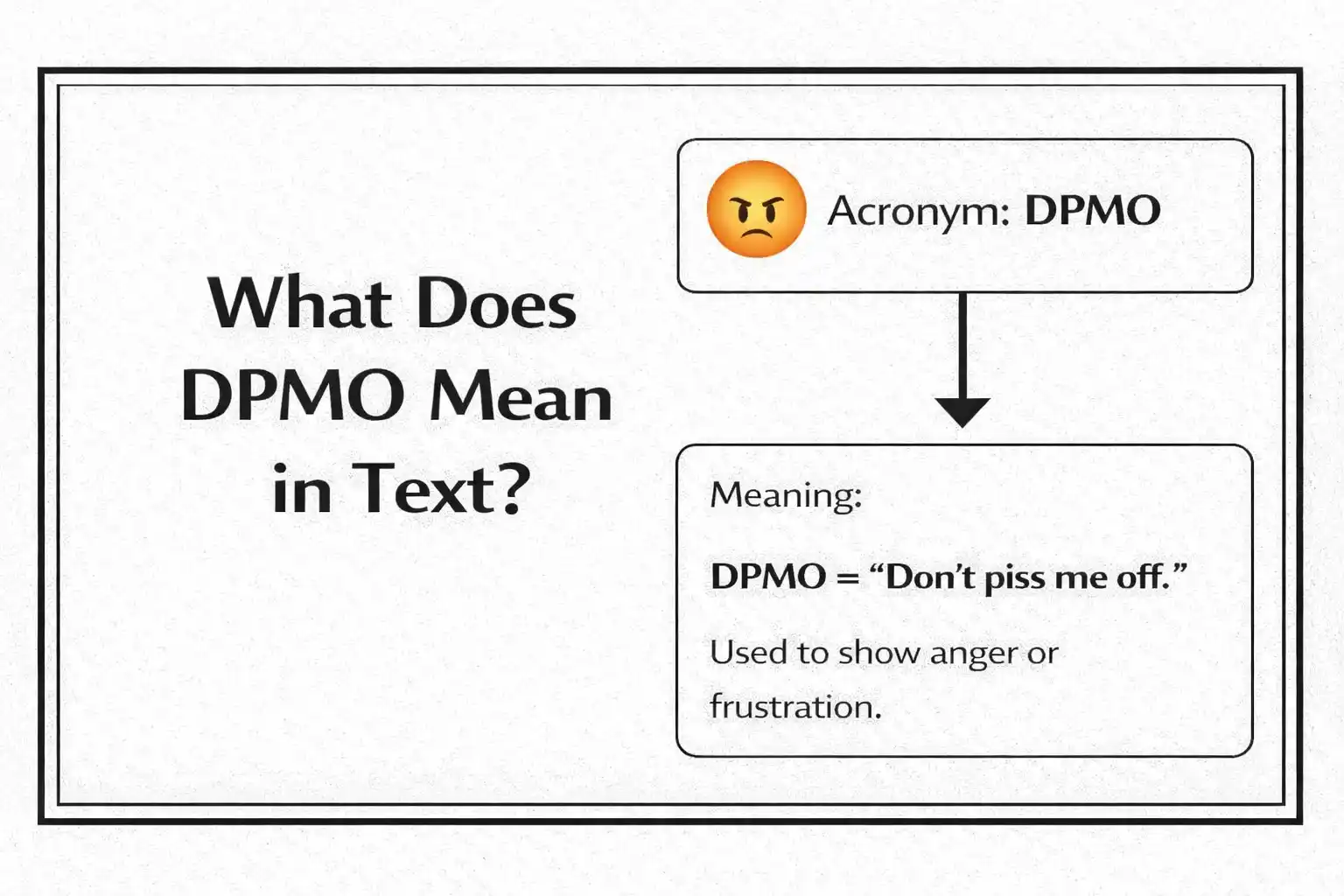
You see DPMO in a message and your brain goes:
“Is this maths? Work stuff? What??”
Don’t worry.
In normal texting and chat, DPMO is just slang.
The short, simple answer:
DPMO in text usually means “Don’t piss me off.”
So when someone types DPMO, they are saying:
- “Stop annoying me.”
- “You’re pushing it.”
- “I’m getting angry. Back off.”
But that’s not the only meaning.
In business and quality control, DPMO is also used for:
DPMO = Defects Per Million Opportunities
(a way to count how many mistakes happen in a process)
This article explains both meanings in very easy language, with:
- clear tables
- real chat examples
- how to tell which meaning is used
- how to reply
So you can use it on your site without “low value content” issues.
Quick Answer: DPMO Meaning in Text
Let’s keep it super simple.
- In chat / text / DMs →
DPMO = Don’t Piss Me Off - In work / factory / quality / Six Sigma →
DPMO = Defects Per Million Opportunities
For your keyword “what does DPMO mean in text”, the main meaning is the first one:
“Don’t piss me off.”
All DPMO Meanings in One Simple Table
Here is a quick table you can use near the top of your article:
| Where it’s used | DPMO meaning | What that means in easy words |
|---|---|---|
| Texting, chat, DMs | Don’t piss me off | Stop annoying me / you’re making me angry |
| Business, factories, quality | Defects Per Million Opportunities | How many mistakes happen if there are 1,000,000 chances |
| Old military / office names | Various office titles | Very rare, not used in normal chat |
Most readers who search “DPMO meaning in text” want the slang meaning, so we’ll focus on that first.
Main Chat Meaning: DPMO = “Don’t Piss Me Off”
When someone sends DPMO in a chat, they are usually warning you:
“Don’t make me angry.”
It is short, but it feels strong.
It shows annoyance, stress, or a limit.
What DPMO is really saying
DPMO can mean:
- “You’re being too much.”
- “You’re going too far.”
- “Please stop this.”
- “I’m not in the mood for this.”
How strong it feels depends on:
- your relationship with the person
- the emojis they use
- the topic
- the whole conversation
Let’s break it into 3 styles.
1. Serious DPMO (Real Anger)
Sometimes, DPMO is not a joke at all.
The person is truly upset.
Examples:
- “I said I don’t want to talk about that. DPMO.”
- “You keep lying. DPMO, I’m actually done.”
- “If you talk to me like that again, DPMO.”
Here, they are clearly saying:
- “Enough.”
- “You crossed the line.”
- “This is not okay.”
This is the strongest way DPMO is used.
2. Half-Joking DPMO (Play Angry)
With close friends, people sometimes use DPMO in a funny way.
They pretend to be angry, but they are also laughing.
Examples:
- “You ate my fries again?? DPMO 😂”
- “If you post that ugly pic of me, DPMO 😭”
- “Flirting with my crush? DPMO 😤”
You can see:
- laughing emojis
- crying emojis
- silly tone
It still means “stop that,” but it is softer and more playful.
3. Soft Boundary DPMO (Don’t Do That)
Sometimes DPMO is used when someone wants to set a clear boundary, but they are not fully exploding.
Examples:
- “Don’t joke about my family, DPMO.”
- “Stop bringing up my ex every time, DPMO.”
- “You keep making fun of my weight, DPMO.”
Here, they might not be shouting, but they are saying:
“This topic hurts me. Please stop.”
DPMO Meaning in Text: Example Table
You can use this table to show context + emotion:
| Situation | Message with DPMO | What they really feel |
|---|---|---|
| Friend keeps teasing you | “Say that one more time and DPMO.” | I’m almost angry. Stop now. |
| Someone spamming your phone | “Stop calling me every 2 mins, DPMO.” | You’re annoying me. |
| Joking about food | “Touch my burger and DPMO 😂” | I care, but I’m joking too. |
| After broken plans again | “You cancelled again? DPMO fr.” | I’m tired of this. I’m upset. |
| Defending a friend | “Talk about me all you want, but her? DPMO.” | Don’t disrespect my friend. |
| Hard limit on a topic | “Don’t talk about my family like that. DPMO.” | This is serious. I won’t accept this. |
This makes it very easy for readers to understand how DPMO is used in real life.
DPMO on Different Apps (Snapchat, TikTok, WhatsApp, etc.)
To keep your article strong for search and helpful for users, show how DPMO appears across apps.
On Snapchat
On Snapchat, people use DPMO in:
- chat replies
- text over snaps
- private stories
Examples:
- Snap of messy hair: “If you post this, DPMO 😤”
- Snap of alarm at 5am: “Early shift again… DPMO.”
- Chat: “You snapped me 20 times while I was asleep, DPMO 😂”
On Instagram
On Instagram, DPMO can appear in:
- story captions
- DMs
- comments between close friends
Examples:
- Story: “Wifi down for the 3rd time today… DPMO.”
- DM: “If you tag me in that, DPMO 😭”
- Comment: “You cropped me out again, DPMO 😂”
On TikTok
On TikTok, you might see DPMO:
- in video captions
- on-screen text
- in comments reacting to something annoying
Examples:
- Caption: “When your alarm doesn’t ring on exam day… DPMO.”
- Text in video: “Teachers: ‘Group project’ – me: DPMO.”
- Comment: “My boss texting me on Sunday… DPMO fr.”
On WhatsApp / iMessage
On normal texting apps, DPMO appears in regular conversations:
- “I told you I’m busy, DPMO.”
- “Call me one more time while I’m in a meeting and DPMO.”
- “If you show my mom that chat, DPMO 😭”
On Discord / Gaming Chats
In gaming chats and Discord servers, DPMO is often used when:
- someone trolls
- someone plays badly on purpose
- people are tilted (frustrated in-game)
Examples:
- “Stop throwing the game, DPMO.”
- “If you steal my loot again, DPMO 😂”
- “Queuing us into ranked while I’m lagging? DPMO.”
Is DPMO Rude?
Most of the time, yes.
Remember, DPMO = “Don’t piss me off.”
That is not polite language.
When it’s less rude
It can be okay when:
- you are talking to close friends
- you all joke in that style
- everyone understands it’s playful
- there are laughing emojis or light tone
Example:
- “Eat my chips and DPMO 😂”
This is more funny than scary.
When it’s a bad idea
You should not use DPMO as slang with:
- boss or manager
- teacher or professor
- customers or clients
- people you don’t know well
- people who don’t like strong language
In these cases, DPMO can look:
- disrespectful
- unprofessional
- aggressive
So, in work or formal places, avoid DPMO as slang.
Softer Alternatives to DPMO
Sometimes you want to say “please stop” or “I don’t like this,” but you don’t want to sound harsh.
Here are better, softer lines you can suggest:
| Instead of DPMO… | Say this instead… |
|---|---|
| “DPMO.” | “Please don’t do that.” |
| “Bro, DPMO.” | “You’re pushing it now, chill.” |
| “Say that again and DPMO.” | “I really don’t like that, can you stop?” |
| “Spam me again and DPMO.” | “Stop spamming me, it’s annoying.” |
| “DPMO about my family.” | “Jokes about my family aren’t funny to me.” |
These still set a boundary, but in clear and calmer language.
Other Meaning: DPMO in Business (Defects Per Million Opportunities)
Now let’s talk about the other meaning of DPMO.
This one is not slang. It is used in business and quality control.
Here, DPMO means:
Defects Per Million Opportunities
Let’s explain that with very easy words.
Simple idea
Imagine a factory that makes phones.
- Every phone has many parts.
- Each part is a chance for a mistake (a defect).
- The company wants to know:
“If we had 1,000,000 chances, how many times would we mess up?”
DPMO is a number that answers this question.
- A low DPMO → very few mistakes → good quality.
- A high DPMO → many mistakes → bad quality.
You see this meaning in:
- factory reports
- quality control training
- Six Sigma lessons
- business presentations
You do not see this meaning in normal chat with friends.
Simple comparison: slang vs business meaning
| Topic | Slang DPMO | Business DPMO |
|---|---|---|
| Full phrase | Don’t piss me off | Defects Per Million Opportunities |
| Who uses it | Friends, online users | Engineers, quality teams, managers |
| Where it appears | Chat, DMs, comments | Reports, slides, work documents |
| Emotion | Strong emotion (anger, annoyance) | No emotion (just numbers and counting) |
| Good for formal use? | No | Yes (but only with the business meaning) |
This makes your article look complete and “entity rich,” but still very simple.
How to Tell Which DPMO Someone Means
Because there are two main meanings, you need to check the context.
Ask yourself:
1. What are they talking about?
- Are they talking about feelings, drama, jokes, friends?
→ That’s the slang meaning: Don’t piss me off. - Are they talking about quality, factory, process, Six Sigma, defects, errors?
→ That’s the business meaning: Defects Per Million Opportunities.
2. What’s the tone?
- Emotional, angry, joking, emojis → slang
- Serious, number-focused, work talk → business
3. Look at the whole sentence
- “If you say that again, DPMO.” → slang
- “Our DPMO is too high this month.” → business
Very easy to see the difference.
4. If you’re not sure, ask
It’s totally fine to ask:
- “DPMO as in ‘don’t piss me off’ or the work thing?”
- “Do you mean the quality DPMO or the slang?”
This avoids misunderstandings, especially in mixed work + friends chats.
How to Reply When Someone Sends DPMO
Your answer should depend on their tone and your relationship.
If they are clearly joking
Example:
“If you eat my fries again, DPMO 😂”
You can:
- laugh with them
- promise not to do it
- tease them back a bit
Replies you can use:
- “😭 okay okay I’ll behave”
- “Relax, I’ll buy you more next time 😂”
- “Noted, fries are sacred 😂”
If they sound serious or angry
Example:
“I told you, don’t joke about that. DPMO.”
Best replies are calm and respectful:
- “Okay, I’ll stop.”
- “Sorry, I didn’t know it bothered you that much.”
- “My bad, I won’t bring it up again.”
This shows you heard them and you will respect their boundary.
If you don’t like that they used DPMO
You also have feelings.
If you feel attacked or disrespected, you can say so.
Examples:
- “You don’t need to talk to me like that.”
- “We can talk without getting rude.”
- “If you’re upset, tell me, but don’t talk to me like that.”
This sets your boundary without shouting back.
Related Slang You Can Mention or Link To
DPMO often appears near other strong or emotional slang.
You can build internal links around these:
- SS – screenshot / so sorry / stay safe
- FS – for sure / full send
- TTM – talk to me / text me
- HRU – how are you
- SMH – shaking my head
- IDC – I don’t care
- IDGAF – I don’t give a f***
All of these are part of the same “chat language” world, so Google will see your site as a good source for “meaning in text” terms.
FAQs: DPMO Meaning in Text
In texting, DPMO usually means “don’t piss me off.” It’s a short way to say “stop before I get angry.”
It uses the word “piss,” which is rude or impolite in many situations. It’s not the worst swear word, but it is not nice language.
No. Do not use DPMO as slang in school, work, or formal places. It can look very disrespectful.
At work, especially in factories or quality control, DPMO usually means “Defects Per Million Opportunities.” This is a way to measure how often mistakes happen in a process.
It exists and people do use it, but it’s not as common as simple phrases like “you’re pissing me off” or “you’re annoying me.” You might see it more in certain friend groups or online circles.
If it’s a joke, you can laugh and promise not to do the thing again.
If it’s serious, it’s better to stop what you’re doing, say sorry if needed, and respect their boundary.
Short Summary: DPMO Meaning in Text
- Main meaning in chat:
DPMO = Don’t piss me off
→ a warning, often angry or half-joking - Other meaning in business:
DPMO = Defects Per Million Opportunities
→ a number used to measure mistakes - It is usually rude as slang, so don’t use it in formal or professional places.
- Always look at the topic, tone, and full sentence to know which meaning someone is using.
Now you fully understand what DPMO means in text, and you can explain it to your readers in easy, clear language that still feels complete and helpful.

About Grayson
Grayson is a professional English language teacher and the founder of WordEncyclo. With years of teaching experience, he specializes in vocabulary development, etymology, and word usage. His mission is to make English words and their meanings accessible to learners at all levels through clear, accurate, and well-researched content.