You’re writing an essay, a craft tutorial, or a work email and you type:
“I’m glueing the pieces together.”
A red line pops up under glueing.
You sigh, try again:
“I’m gluing the pieces together.”
Now the red line is gone.
Your brain goes:
“Wait… is it glueing or gluing? Which one is actually right?”
If that question has ever slowed you down, this guide is for you.
We’ll go step by step in very easy language, just like the other slang articles you liked, and we’ll make sure the answer sticks in your mind like… well… glue.
Quick Answer: Always Choose “Gluing”
Let’s start simple.
In modern English, the correct and normal spelling is:
✅ gluing
The word:
❌ glueing
is not the standard spelling. You might see it sometimes, but most teachers, editors, exams, and spell-checkers treat gluing as correct and glueing as wrong or at least old-fashioned.
So in almost every situation:
- homework
- exams
- business emails
- tutorials and blog posts
- how-to instructions
- craft books
you should write gluing, not glueing.
If you only wanted the short answer to glueing or gluing, you already have it.
But if you want to really understand why, keep reading.
Why “Gluing” Is Correct: The Easy Spelling Rule
Why do we drop that e? There’s actually a simple pattern.
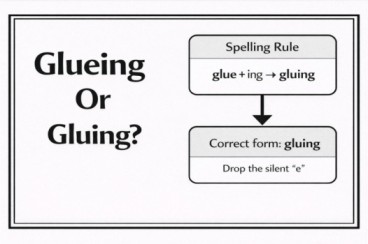
In English, when a verb ends in a silent “e” and we add -ing, we usually:
drop the “e” and add “-ing”
Here are some examples:
- bake → baking (not bakeing)
- move → moving (not moveing)
- type → typing (not typeing)
- use → using (not useing)
- drive → driving (not driveing)
So when we talk about glueing or gluing, we follow the same rule:
- glue → gluing (drop the e + add ing)
We don’t usually write:
- ❌ glueing
Just like we don’t write:
- ❌ bakeing
- ❌ moveing
- ❌ typeing
This is why your spell-checker keeps trying to “fix” glueing to gluing.
It’s following this very common spelling rule.
Glueing or Gluing in American and British English
Sometimes spelling is different in American and British English:
- color / colour
- center / centre
- organize / organise
So it’s fair to ask:
“Maybe glueing is British and gluing is American?”
Good question, but in this case the answer is easy.
| English type | Normal spelling | Notes |
|---|---|---|
| American English | gluing | Used in US schools, exams, and style guides |
| British English | gluing | Also the usual choice in the UK and many other countries |
| Rare / older form | glueing | You might see this sometimes, but it’s not standard now |
So:
- If you’re writing for an American audience → use gluing.
- If you’re writing for a British or international audience → still use gluing.
Both sides agree on this one.
So the glueing or gluing question doesn’t depend on the country.
The safe answer is gluing everywhere.
All the Verb Forms of “Glue” (So You See Where “Gluing” Fits)
It can help to look at the word glue in all its main forms.
Only one of them causes the “glueing or gluing” confusion.
| Verb form | Example sentence |
|---|---|
| base form: glue | Please glue the picture to the card. |
| 3rd person singular: glues | She glues everything very neatly. |
| past tense: glued | We glued the pieces together yesterday. |
| past participle: glued | The model is already glued and ready to paint. |
| present participle / gerund: gluing | He is gluing the tiles to the wall right now. |
Only the -ing form makes us ask:
“Is it glueing or gluing?”
Now you know: it’s gluing.
Lots of Simple Example Sentences With “Gluing”
Let’s load your brain with examples so gluing feels normal and natural.
Everyday life examples
- I am gluing the handle back onto the mug.
- She is gluing the broken toy so the child can play with it again.
- They are gluing the photos into a family album.
- We spent the afternoon cutting and gluing pieces of colored paper.
- He kept gluing things to his notebook until the cover was full.
School and kids’ craft examples
- The students are gluing glitter onto their birthday cards.
- Please stop gluing things to the desk; use the paper instead.
- After gluing the shapes, write your name at the top of the page.
- Today in art class we did a lot of painting and gluing.
- When you’re done gluing, put the cap back on the glue stick.
DIY and home project examples
- When gluing wood, clamp the boards and let them dry overnight.
- I’m gluing decorative stones around the mirror frame.
- We are gluing foam panels to the wall for soundproofing.
- After gluing the tile, wipe away any extra glue with a damp sponge.
- Wear gloves while gluing plastic because the glue is very strong.
Work or instruction examples
- Step 4: Begin gluing the pieces in the pattern shown.
- Avoid gluing near open flames or hot surfaces.
- After gluing the label, press firmly for ten seconds.
- The machine is used for gluing the box flaps closed.
- Workers must wear safety glasses while gluing parts on the assembly line.
Every one of those sentences uses gluing, and every one would look strange with glueing instead.
Why Do We Drop the “e” in “Gluing” But Double Letters in “Running”?
Another common confusion:
If we drop the e in glue → gluing, why do we double letters in other words, like run → running?
Here’s the simple version.
Pattern 1: Silent “e” at the end
If a verb ends in silent e, we usually:
drop “e” + add “-ing”
Examples:
- bake → baking
- move → moving
- type → typing
- save → saving
- glue → gluing
Pattern 2: Short vowel + single consonant
If a verb ends with a short vowel + one consonant, and the stress is on that last syllable, we usually:
double the last consonant + add “-ing”
Examples:
- run → running
- sit → sitting
- jog → jogging
- plan → planning
- stop → stopping
So:
- bake → baking (NOT bakeing)
- glue → gluing (NOT glueing)
- jog → jogging (NOT joging)
That’s why we say gluing, not glueing.
Different rule, different pattern.
Is “Glueing” Wrong, or Just Old?
You might still think:
“But I swear I’ve seen glueing somewhere!”
You’re not crazy.
Glueing does exist, but it’s unusual now.
Where you might see it:
- in older books
- in old instruction manuals
- on random websites where people didn’t use spell check
- sometimes in texts from people who learned that spelling years ago
But language changes over time.
Today:
- most major dictionaries list gluing as the main form
- “glueing” is usually marked as “less common” or not listed at all
- tools like Word and Google Docs treat glueing as a mistake
So if you’re doing modern writing, especially for school or work, it’s best to treat gluing as the correct spelling and glueing as a spelling you avoid.
“Gluing” as Verb, Noun, and Adjective (All Same Spelling)
The word gluing can act in three different ways, but the spelling never changes.
1. As part of a verb
This is the most common use.
- I am gluing the photos.
- They were gluing the cardboard pieces together.
- She is still gluing the decorations onto the wall.
2. As a noun (gerund)
Here gluing names an activity, like “swimming” or “drawing.”
- Gluing is the messiest part of this project.
- We did a lot of gluing in art class today.
- Too much gluing can make the paper warp.
3. As an adjective
Here gluing describes a tool or instructions.
- Read the gluing instructions before you start.
- You may need a special gluing brush for small parts.
- The kit includes a gluing guide inside the box.
In all three roles—verb, noun, adjective—the spelling stays the same: gluing.
You never have to change it or add a hyphen like glue-ing.
Just one simple word.
Table: Glueing or Gluing plus Similar Verbs
Let’s compare glue with other verbs that follow the same pattern.
| Base verb | Correct -ing form | Wrong-looking form | Example sentence |
|---|---|---|---|
| glue | gluing | glueing | I am gluing the photo to the card. |
| use | using | useing | She is using a glue stick. |
| move | moving | moveing | We are moving the table after gluing it. |
| bake | baking | bakeing | He is baking cookies while I’m gluing decorations. |
| type | typing | typeing | I’m typing the instructions for gluing the model. |
| save | saving | saveing | We’re saving time by gluing, not sewing. |
Seeing these side by side makes the rule feel more natural:
drop the silent “e” → add “-ing.”
10. Common Phrases With “Gluing” You Can Reuse
If you’re writing a long article or assignment and want a variety of phrases, here are some simple ones you can plug into your sentences.
- gluing pieces together
- gluing the broken parts
- gluing paper to cardboard
- gluing fabric to foam
- gluing tiles in place
- gluing labels onto jars
- gluing photos into a scrapbook
- gluing decorations onto a poster
- gluing wood joints
- gluing edges carefully
Example:
“The most time-consuming part of the project was gluing pieces together and waiting for them to dry.”
You can mix and match these to make your writing feel natural and not repetitive.
Practice Section: Fix the Spelling
Let’s do a bit of practice to lock in the answer to glueing or gluing.
A. Choose the correct form
Pick the correct spelling in your head: glueing or gluing.
- She is ___ fabric onto the cardboard.
- We were ___ tiny beads onto the costume.
- After ___ the frame, let it dry for twenty minutes.
- The children spent the morning cutting and ___.
- Wear a mask when ___ pipes with strong glue.
Answers:
- gluing
- gluing
- gluing
- gluing
- gluing
Always the same: gluing wins every time.
B. Fix the sentence
Each sentence below has the wrong spelling. Fix it in your head or on paper.
- I am glueing the pictures into my notebook.
- They were glueing the broken chair back together.
- After glueing the tiles, wipe away the extra glue.
- Glueing is my favourite part of art class.
- We used a special brush for glueing the small parts.
Correct versions:
- I am gluing the pictures into my notebook.
- They were gluing the broken chair back together.
- After gluing the tiles, wipe away the extra glue.
- Gluing is my favourite part of art class.
- We used a special brush for gluing the small parts.
If you automatically want to write gluing now, you’re in a good place.
Why Spell-Check Keeps “Fixing” You
You might feel annoyed when Word or your phone keeps changing glueing to gluing.
But here’s what’s really happening:
- Those programs follow big dictionaries and style guides.
- Those references all treat gluing as the standard form.
- Their job is to push you towards the most accepted spelling.
So when spell-check underlines glueing, it’s not random—it’s doing exactly what it’s supposed to do.
In other words:
If you’re ever unsure about glueing or gluing and spell-check says “gluing,” trust it.
FAQ: Glueing or Gluing?
The standard modern spelling is gluing.
“Glueing” is a rare or older form and is usually marked as wrong.
Because the verb glue ends in a silent e, and our spelling rule says:
drop the silent e + add -ing
So:
glue → gluing
move → moving
bake → baking
You might see “glueing” in old books or random places online, but for school, work, and most modern writing, you should stick with gluing. That’s what teachers, exams, and editors expect.
No. Both American and British English normally use gluing.
“Glueing” is not a standard British spelling in modern use; it’s just a less common alternative.
No. They would be pronounced the same way: “GLOO-ing.”
The difference is only in spelling, not pronunciation.
base verb: glue
3rd person: glues
past tense: glued
past participle: glued
-ing form: gluing
Only the -ing form raises the glueing or gluing question.
Final Easy Line to Remember
Let’s finish with one short sentence you can keep in your head:
When you write about sticking things together with glue, the correct spelling is gluing, not glueing.
If that one line stays with you, you’ll never have to stop and wonder about glueing or gluing again—your writing will already be stuck together just right.

About Grayson
Grayson is a professional English language teacher and the founder of WordEncyclo. With years of teaching experience, he specializes in vocabulary development, etymology, and word usage. His mission is to make English words and their meanings accessible to learners at all levels through clear, accurate, and well-researched content.