You’re scrolling through Snapchat, Instagram DMs, TikTok comments, or a Discord server.
Someone sends a message, maybe a little rude or a little flirty, and then adds:
“jp”
You stop and think: “Okay, what does jp mean in text? Are they serious or just messing around?”
If that sounds like you, don’t worry. A lot of people see “jp” in chats and aren’t 100% sure what it stands for. This guide explains the jp meaning in text in very simple terms, with lots of examples and related phrases.
We’ll cover:
- the basic meaning
- examples from real-life texting
- how it compares to “jk” and other slang
- other possible meanings (Japan, job posting, etc.)
- when you should and shouldn’t use it
- how to answer when someone sends “jp”
All in easy language you can read and use right away.
Quick Answer: What Does “jp” Mean in Text?
In everyday texting, gaming chat, and social media, the jp meaning in text is:
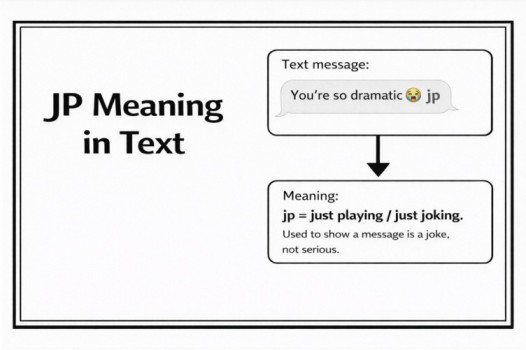
“just playing” or “just joking / just kidding.”
So if someone sends a message and adds “jp” at the end, they’re telling you:
- “I’m not being serious.”
- “I’m just teasing.”
- “Don’t get mad, it’s a joke.”
“JP” is short, casual, and fits the fast style of modern messaging on apps like:
- iMessage
- Snapchat
- Facebook Messenger
- TikTok DMs
- Discord
- gaming chat (Xbox, PlayStation, PC games)
Any time conversation is quick and playful, you might see “jp” pop up.
Why People Use “jp” Instead of Writing the Whole Phrase
Typing “just playing” or “just joking” every time you make a joke takes longer. Most people want to send short, fast messages.
That’s why short forms and abbreviations exist in internet slang:
- “jk” = just kidding
- “lol” = laughing out loud
- “lmao” = laughing my ass off
- “idk” = I don’t know
- “brb” = be right back
“jp” fits into this same group. It is quick and easy to type, especially on a phone.
But it does more than save time. The jp meaning in text is also about tone. It changes how your message feels.
Without “jp,” a message could sound angry, rude, or serious.
With “jp,” it sounds softer, more like a joke.
How “jp” Changes the Tone of a Message
Text messages have a big problem: you can’t hear the other person’s voice. You don’t see their face, you don’t hear them laugh. Things can sound harsher in text than they do in real life.
That’s why tone markers and internet slang exist. Words like:
- “jp”
- “jk”
- “lol”
- “/j” (joking)
- “/s” (sarcasm)
help us show the emotion behind what we’re saying.
When someone adds “jp,” they are doing one or more of these:
- trying not to hurt your feelings
- turning a strong statement into a friendly tease
- making sure you know they’re not serious or angry
- keeping the conversation light and playful
So the jp meaning in text is not just a translation of letters. It’s a signal:
“Read this like a joke, not like an attack.”
Real Chat Examples Showing JP Meaning in Text
Let’s look at some real-style examples. These could be from Snapchat, WhatsApp, Instagram, or Discord.
Example 1 – Light teasing between friends
Friend: “Bro you’re always late to everything 😭 jp love you”
Here, “jp” means just playing. The friend is teasing about being late but doesn’t want it to sound like real anger.
Example 2 – Gaming chat on Discord
Player 1: “You’re the reason we lost that match 😂 jp”
Player 2: “chill 😂”
Gamers often tease each other. “jp” shows it’s playful trash talk, not a direct attack.
Example 3 – Flirty conversation on Instagram
Person A: “You miss me, don’t you?”
Person B: “In your dreams 😏 jp… maybe a little”
Here the person uses “jp” to joke, but also to test the waters. There’s a mix of humor and real feeling.
Example 4 – Softening strong criticism
“That outfit is illegal 💀 jp it actually looks good”
Without “jp,” “That outfit is illegal” could sound mean. With “jp,” it reads as a playful compliment.
Example 5 – Group chat chaos
“You two argue like an old married couple 😭 jp”
In a group chat on Snapchat or Messenger, “jp” keeps the mood friendly even when someone points something out.
These examples show that the jp meaning in text is usually friendly teasing or a soft joke, not real insult.
“jp” vs “jk” vs Other Slang
You might wonder: if “jp” and “jk” both mean “just joking,” is there any difference?
jp
- Stands for “just playing” or “just joking.”
- Very casual.
- Common in gaming communities, Discord servers, younger texting culture, and TikTok comments.
jk
- Stands for “just kidding.”
- Very widely known. Older and younger people both use it.
- Feels a little more neutral and universal.
lol, lmao, etc.
- lol – laughing out loud
- lmao – laughing my ass off
- rofl – rolling on the floor laughing
These focus more on reaction (someone is laughing) rather than saying, “I didn’t mean that seriously.”
/j and /s
On platforms like Twitter/X, Discord, and Tumblr, people sometimes use:
- /j – joking
- /s – sarcasm
These are tone tags. They work similarly to “jp” but appear after the sentence like a label.
Bottom line:
The jp meaning in text is basically the same as “jk,” but it has a slightly more relaxed, “I’m just messing with you” feeling. It’s especially popular in online youth culture and gaming slang.
Other Possible Meanings of “jp”
Most of the time in casual messages, “jp” = just playing / just joking.
But sometimes, especially outside of chat, “JP” can mean other things. Here are a few:
- Japan – “JP” is the country code for Japan. You might see this in shipping addresses, game servers (JP server), or travel posts.
- Job Posting – In HR, LinkedIn, or Slack channels, “new JP” might mean a new job posting.
- Jackpot – In gambling or gaming, “JP” can be short for jackpot.
- Jump – In some notes or technical messages, “jp” can stand for “jump.”
- “Just Pray” – Sometimes in religious chats, people type “jp” as “just pray,” though this is less common.
So how do you know the jp meaning in text in each situation?
Ask a few quick questions:
- Are we chatting like friends, joking around?
→ Probably “just playing / just joking.” - Are we talking about countries, anime, or travel?
→ Could be Japan. - Are we in a work or business chat about hiring?
→ Might be job posting. - Does “just playing” fit the message?
→ If yes, that’s almost always the right answer.
Context is everything.
When You Should Use “jp” (and When You Should Not)
Good times to use “jp”
The jp meaning in text fits well when:
- you’re chatting with friends or close classmates
- the mood is casual and playful
- you’re on Snapchat, TikTok, Instagram, Discord, WhatsApp, etc.
- you made a joke that could sound harsh and want to soften it
Examples:
- “You’re such a clown sometimes 😂 jp”
- “You seriously forgot my birthday?? jp I know you didn’t”
Here “jp” keeps feelings from getting hurt.
Times to avoid “jp”
“jp” can feel wrong or immature in some situations, like:
- work emails or messages to your boss
- messages to a teacher, professor, or advisor
- serious topics like mental health, emergencies, or real arguments
- when the other person is already sad, angry, or in crisis
Example of what not to do:
“I’m not sure I want to be here anymore”
“lol jp”
That kind of message is confusing and can be very upsetting.
Serious topics need clear, respectful language, not “jp.”
If you said something wrong in a serious chat, it’s better to say:
- “Sorry, that came out wrong.”
- “I was trying to make a joke, but that wasn’t okay.”
- “Let me explain what I meant.”
“JP” is for light, safe jokes—not for covering up hurtful comments in tough moments.
How to Reply When Someone Uses “jp”
If someone ends a message with “jp,” here are easy ways to answer.
If you got the joke
Respond with something that shows you understand:
- “😂 got it”
- “lol ok”
- “I knew you were jp”
- “you play too much 😭”
This keeps the mood light.
If your feelings were a bit hurt
Still stay calm, but be honest:
- “I know you said jp but that kinda hurt ngl.”
- “Please don’t jp about that topic.”
- “All good, just not funny to me.”
This sets a boundary without turning it into a huge fight.
If you don’t understand the slang
It’s always okay to ask:
- “What does jp mean?”
- “jp as in just playing?”
- “Sorry, I don’t know that slang.”
Most people are happy to explain.
Can “jp” Hide Real Feelings?
Sometimes, yes.
People sometimes say something they actually think, then add “jp” to make it safer. It’s a way to test reactions.
Example:
“You never text first 😒 jp”
They might really feel that you never start the conversation, but they use “jp” so it doesn’t sound like a full complaint.
Or:
“You’d look good with me 😏 jp… unless?”
Here “jp” is half joke, half “I’m actually a little serious.”
So when you see “jp,” ask yourself:
- Does this sound like something they might really think?
- Have they said similar things before without jp?
- Are they smiling through text but maybe hiding feelings?
The jp meaning in text can be “just joking,” but sometimes it’s “just joking… sort of.”
Do’s and Don’ts for Using “jp” Yourself
Here’s a quick list to make sure you use “jp” in a smart way.
Do
- Use it with friends who know your sense of humor.
- Use it when you say something that might sound mean or serious.
- Add emojis or “lol” around it if you want the joke feeling to be very clear.
- Keep it lowercase (jp) to match normal texting style.
Don’t
- Use it to excuse genuinely harsh comments.
- Use it in serious conversations about feelings, health, or big life problems.
- Use it in formal chats with teachers, bosses, or clients.
- Overuse it in every message—it will start to look childish.
A good rule of thumb:
If you wouldn’t say the joke out loud in front of the person, maybe don’t hide behind “jp” in text.
Quick Table: JP Meaning in Different Contexts
| Platform / situation | Example message | Meaning of “jp” here |
|---|---|---|
| Snapchat streak chat | “Your snaps are cursed 💀 jp they’re funny” | just playing / joking |
| TikTok comment | “POV: you think this outfit is cute 😭 jp it ate” | joking compliment |
| Discord gaming server | “You sold that round hard 😂 jp ggs” | friendly tease after a game |
| Instagram DM | “You lowkey like me jp? 👀” | half-joke, testing interest |
| Travel group message | “Anyone from JP here?” | JP = Japan |
| Work Slack channel | “New JP is live in the careers page” | JP = job posting |
Most of the time, especially with emojis and casual slang, the jp meaning in text will be the first row: just playing / just joking.
FAQ: Common Questions About JP Meaning in Text
A: By itself, no. It’s just slang for “just playing.” It can feel rude if the message before it was harsh or offensive.
A: Yes, it’s more common among teens and young adults, especially in online communities, but anyone can use it if they’re in a casual setting.
A: Both work. “jk” is more widely understood. “jp” feels a bit more playful and gaming-style. Use the one that fits your friend group.
A: It can, if the joke is about a sensitive topic. Even if you say “jp,” the other person might still feel hurt. Always think about the person reading it.
A: Usually, yes. Most people place it after the main message:
“That was lowkey trash jp 😂”
Simple Summary: JP Meaning in Text
To put everything in one short, clear line:
The jp meaning in text is “just playing” or “just joking.” It’s used in chats and social media to show that a message is meant as a joke, not something to take seriously.
You’ll see it a lot in casual conversations on Snapchat, Instagram, TikTok, Discord, and WhatsApp, usually after teasing or playful comments. Context matters, but if the message feels like a joke, “jp” almost always means they’re just playing around.
Now that you know what “jp” means in text, you can read your messages with more confidence—and use the slang yourself when you want to keep things light and friendly.

About Grayson
Grayson is a professional English language teacher and the founder of WordEncyclo. With years of teaching experience, he specializes in vocabulary development, etymology, and word usage. His mission is to make English words and their meanings accessible to learners at all levels through clear, accurate, and well-researched content.