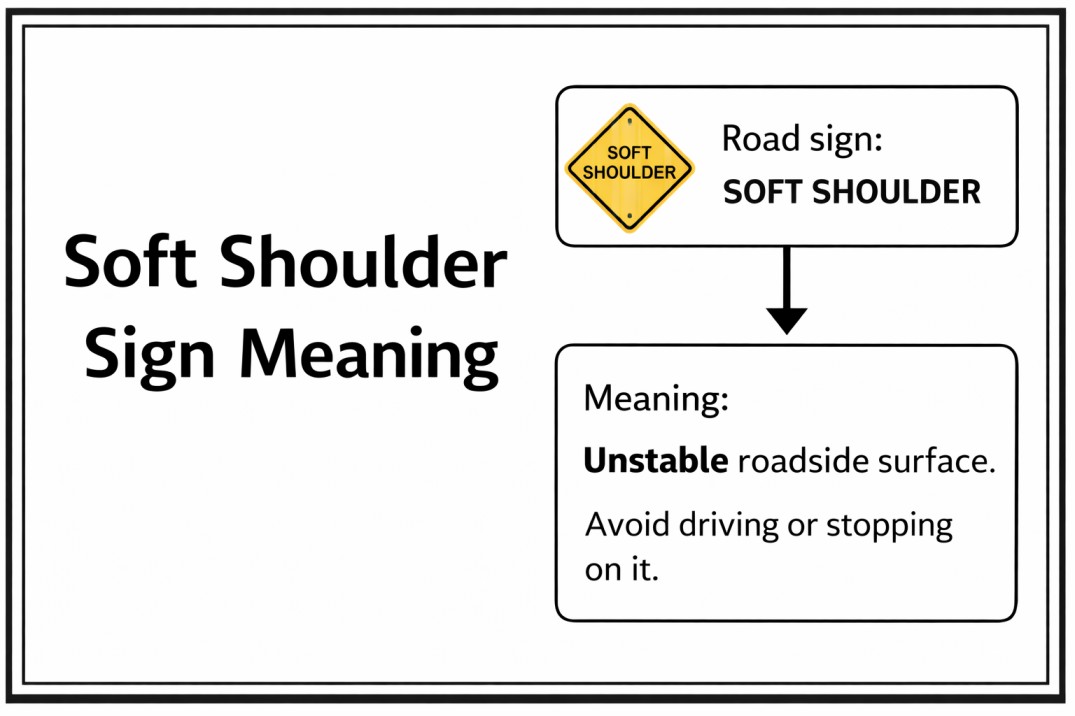
You’re driving along a two-lane road, the kind with fields or trees on both sides, and suddenly you see a yellow diamond that says SOFT SHOULDER.
No picture, no extra symbol, just the words.
Most people know it means “be careful,” but don’t really think about why or what to do if their tires actually touch that shoulder. That’s where understanding the soft shoulder sign meaning properly makes a big difference.
Below is a simple, human explanation you can use for yourself, for new drivers, or in an article of your own.
What “Soft Shoulder” Really Means
On any road, the shoulder is the strip of land or pavement alongside the travel lane. It’s the area you’d use for an emergency stop or to recover if you drift a little too far to the side.
A soft shoulder is a shoulder that:
- is not fully paved
- is usually made of dirt, gravel, grass, or another loose material
- doesn’t support your vehicle as well as the main road surface
So the soft shoulder sign meaning in plain English is:
“The side of the road is weak and unstable. Avoid driving or stopping on it unless you really have to, and be gentle if your tires go onto it.”
The sign itself is usually:
- a yellow diamond
- with the words SOFT SHOULDER in black letters
It’s a warning sign, not a suggestion. It tells you that the road edge is different from what you might expect and can cause trouble if you treat it like normal pavement.
Why Roads Have Soft Shoulders in the First Place
If soft shoulders are risky, why do they exist at all?
Often it comes down to cost, space, or terrain. Fully paved shoulders are more expensive and require more room. On some roads, especially:
- rural highways
- older country routes
- roads through hills or tight spaces
it’s common for the shoulder to be gravel or compacted dirt instead of asphalt or concrete.
A soft shoulder is still safer than having no shoulder at all or a sharp drop-off right next to the lane. It gives a little room if you wander off the pavement. But because it’s not solid like the roadway, it can:
- crumble under the weight of a car
- become muddy after rain
- hide ruts or holes
- let a vehicle sink slightly or tilt
That’s why there’s a specific warning sign. The soft shoulder sign meaning is basically: “This area is better than a ditch, but not good enough to treat like another lane.”
How a Soft Shoulder Changes the Way Your Car Feels
The most important part of understanding the sign is knowing what might happen if your wheels actually roll onto that soft area.
If your right-side tires drift off the pavement onto a soft shoulder at normal road speed, you may feel:
- the car pulling to the right
- rougher vibration from gravel or dirt
- the vehicle leaning a bit as the shoulder sinks
This can be surprising if you’re not ready for it. Instinct might tell you to jerk the steering wheel back left immediately. That reaction is exactly what causes many crashes.
If you suddenly yank the wheel to get back on the pavement, your car can:
- swing too far left
- cross into the opposite lane
- even spin out or roll if speeds are high and surfaces are uneven
So part of the soft shoulder sign meaning is also a reminder: if you go onto the shoulder, you need a calm, gentle response.
What To Do If Your Wheels Drift Onto a Soft Shoulder
The right way to respond is simple, but you have to resist the panic reaction.
- Stay calm.
Take a breath. You’re still in control. - Ease off the gas.
Don’t slam the brakes. Just gently let the car slow down. - Keep the steering wheel mostly straight.
Let the vehicle ride partly on the shoulder for a moment if necessary. - When your speed comes down, gently steer back onto the pavement.
Make it a smooth, gradual move, not a hard snap. - Once you are fully back on the road, accelerate smoothly to match traffic.
That’s it. No sudden movements, no hard braking unless there’s an immediate danger. The whole idea is to let the car settle and then quietly guide it back.
Knowing this simple procedure is a huge part of really understanding the soft shoulder sign meaning in practical terms.
How “Soft Shoulder” Differs from Other Shoulder Warnings
Sometimes people mix up different shoulder signs, so here’s a quick comparison in plain language.
- Soft Shoulder
The surface beside the road is weak or loose (dirt, gravel, grass). It might not support the vehicle well. - Low Shoulder
The shoulder surface is lower than the pavement, creating a little step down. The height difference can yank the vehicle when you try to climb back up. - No Shoulder
There is basically no extra space at the edge of the road. You often see this on bridges or very narrow roads. - Paved Shoulder
This isn’t always signed. It’s a shoulder made of solid asphalt or concrete. Still not a driving lane, but more stable for emergency stops.
Sometimes you’ll even see “LOW SOFT SHOULDER”, which means the shoulder is both lower and weaker than the pavement.
The main idea: the soft shoulder sign meaning talks about the material, not the height. It warns you the surface itself is unstable.
Is It Ever Okay to Use a Soft Shoulder?
The sign doesn’t mean “never ever touch this area.” It means “use it only if you must and be very careful.”
There are times when you might have no choice:
- your engine starts to fail
- a tire blows out
- someone in the car is having a medical emergency
- there’s something in the lane you suddenly need to avoid
In those cases, the shoulder—soft or not—is still the safer option than stopping in the middle of the road.
If you have to pull onto a soft shoulder, try to:
- signal early
- gently reduce your speed before leaving the pavement
- drift onto the shoulder slowly rather than swerving
- once stopped, turn on your hazard lights so others see you
When it’s time to leave:
- wait for a good gap in traffic
- start moving while you’re still partly on the shoulder
- steer back onto the pavement gradually, not in a snap
- match the speed of traffic smoothly
Again, the key is smoothness. The more gentle your steering and braking, the safer you’ll be on a soft surface.
Why This Sign Matters So Much for New Drivers
Experienced drivers might handle a soft shoulder without thinking, but newer drivers often haven’t felt that sudden change in grip before. For them, the soft shoulder sign meaning is especially important.
Common mistakes new drivers make near soft shoulders:
- drifting off the right edge while distracted and then yanking the wheel back
- using the shoulder as a casual driving lane to go around slower traffic
- pulling off the road too quickly at high speed
- braking hard the moment they feel gravel or dirt
Those reactions are exactly what can lead to a skid or spin. That’s why parents, instructors, and writers who teach about driving should explain the sign clearly and calmly.
A simple way to explain it to a new driver:
“Soft shoulder means the side of the road is loose or weak. If your tire touches it, don’t panic. Slow down gently and then ease back onto the road. Never use it like a passing lane.”
That’s enough to plant the right instinct.
A Few Real-Life Examples
Sometimes examples make the meaning stick better than definitions.
Night driving on a country road
You’re following the curve of a dark two-lane road. You see the SOFT SHOULDER sign. Even if you can’t see the shoulder clearly, you know: “If I drift, the edge is loose.” So you keep both hands on the wheel, avoid distractions, and stay neatly in your lane.
Swerving to avoid an animal
A deer jumps from the side of the road. Your instinct is to jerk the wheel, but you remember the sign you passed a minute ago. Instead of swerving hard onto the shoulder, you brake firmly while keeping the car mostly straight, giving yourself a chance to avoid the animal without losing control.
Pulling over with a flat tire
Your tire starts thumping. The nearest safe area is a soft shoulder. You slow down first, then gently move onto the shoulder, leaving plenty of room from the lane. Because you know the surface is soft, you don’t fight it or jerk the car. You come to a calm stop, switch on your hazard lights, and handle the situation slowly.
In each case, understanding the soft shoulder sign meaning changes your decisions for the better.
Weather and Soft Shoulders
Weather can turn a soft shoulder from “tricky” into “seriously risky.”
After heavy rain, a dirt or grass shoulder can turn into mud. Gravel can wash away, leaving holes or deep ruts. A shoulder that looked solid yesterday might grab your tires today.
In snow and ice, shoulders may not be plowed or salted as well as the main lanes. Hidden under the snow could be:
- drop-offs
- big ruts
- very soft spots
So when you see the sign during bad weather, treat it like an extra warning: stay on the pavement as much as possible, keep your speed reasonable, and give yourself more room to react.
Legal Side: Using the Shoulder
Laws vary by region, but in many places:
- shoulders are for emergency use only
- using a shoulder to pass traffic is illegal
- police can ticket you if you treat the shoulder like a normal lane
The soft shoulder sign meaning quietly reminds you of this too. It’s saying “this is not part of the roadway for regular driving,” both for safety and for legal reasons.
Simple Do’s and Don’ts Near a Soft Shoulder
Here’s a quick, easy list you could remember or even include in a graphic.
Do
- keep a steady lane position and both hands on the wheel
- slow down gently if you accidentally drift onto the shoulder
- use the shoulder only for emergencies or when absolutely necessary
- re-enter the road smoothly and gradually
Don’t
- drive along the shoulder just to pass slower cars
- jerk the wheel left if your tires drop off the pavement
- slam on the brakes the second you feel gravel unless you’re about to hit something
- treat the shoulder like a normal lane
Following these simple habits is a big part of respecting what the soft shoulder sign meaning is trying to tell you.
Short FAQ Y
It means the side of the road is loose or weak, so you should avoid driving or stopping there unless necessary and be gentle if your wheels go onto it.
It can be. Cars can sink, slide, or tilt more easily on dirt, gravel, or mud than on pavement, especially at high speeds or in bad weather.
Yes, if you have an emergency or a serious reason. Just slow down first, move over gradually, and be very careful getting back onto the road.
Soft shoulder is about the surface (loose, not paved). Low shoulder is about the height difference between the pavement and the shoulder.
Ease off the gas and slow down gently. Avoid a sudden hard brake unless there’s immediate danger right in front of you.
Final Thoughts: The Real Message of the Soft Shoulder Sign
When you see that yellow diamond with SOFT SHOULDER on it, the road is quietly giving you some very practical advice:
- the edge is not as strong as the lane
- it might grab your tires or let them sink
- if you end up there, staying calm and moving gently will keep you safe
So the real soft shoulder sign meaning is more than just “the shoulder is soft.” It’s:
“Stay on the pavement if you can. If you can’t, use this space carefully and calmly.”
Once you see it that way, the sign stops being just another piece of roadside clutter and becomes a useful little reminder that helps you drive smarter and safer.

About Grayson
Grayson is a professional English language teacher and the founder of WordEncyclo. With years of teaching experience, he specializes in vocabulary development, etymology, and word usage. His mission is to make English words and their meanings accessible to learners at all levels through clear, accurate, and well-researched content.