
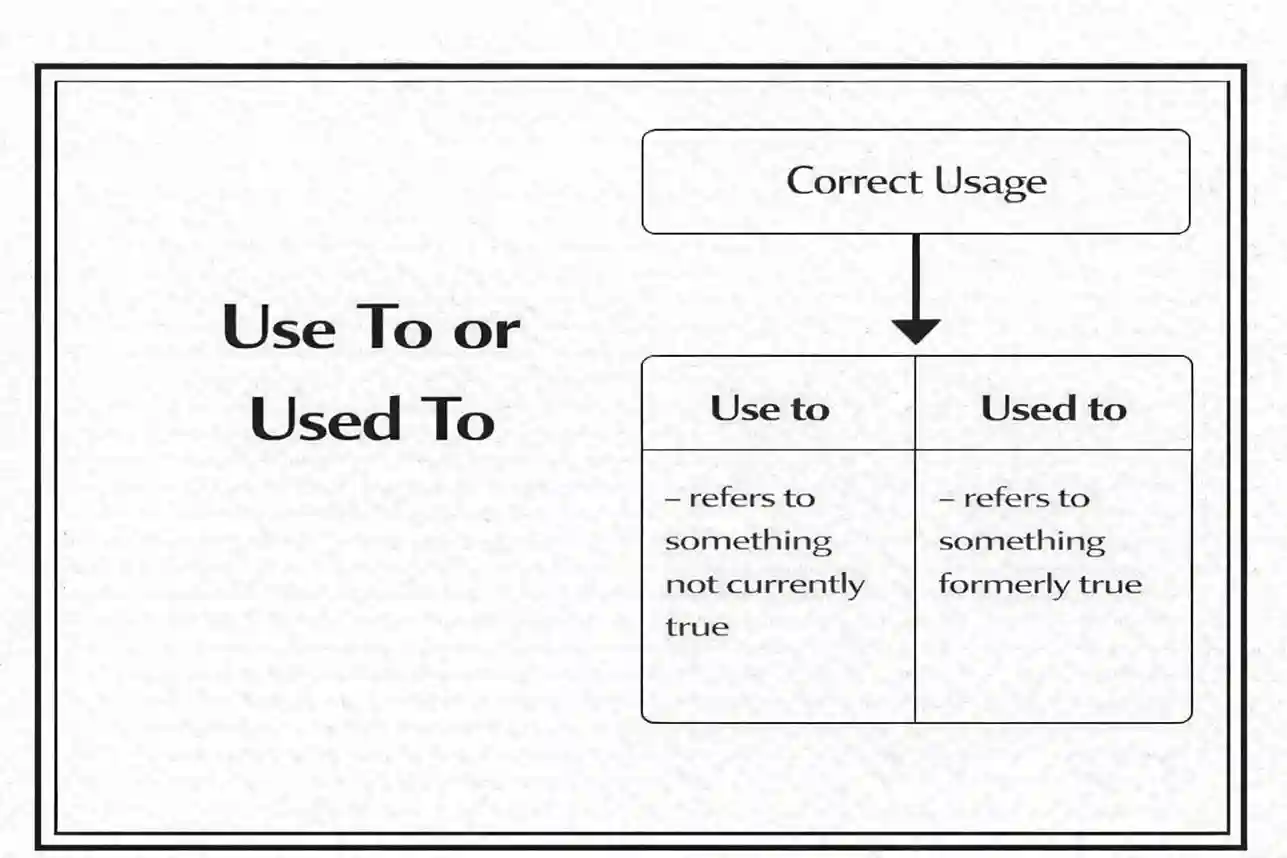
You’re typing a sentence and suddenly stop:
Should I write use to or used to?
“I use to go there” or “I used to go there”?
You see both versions online. Sometimes friends type use to, sometimes teachers say used to. Spell check may not always help. It can feel annoying and embarrassing, especially if you care about good English.
Let’s fix that today.
The good news:
Once you understand when English grammar drops the “d” and when it keeps it, Use To or Used To becomes very simple.
Quick Answer – Use To or Used To?
Here is the short, clear rule:
- In normal positive sentences, the correct form is “used to”.
- In negative sentences and questions with “did”, we write “use to” because “did” already shows the past.
So:
- ✅ I used to play football every day.
- ✅ I didn’t use to play football.
- ✅ Did you use to play football?
The meaning is always about the past, usually a past habit or a past situation that is not true now.
Now let’s go deeper into Use To or Used To with easy examples.
What Does “Used To” Mean?
When people think about Use To or Used To, they usually mean the phrase:
used to + base verb
This is used to talk about:
- past habits
- past routines
- past facts or states
that are not true anymore.
In simple words:
“Used to” = something was true or regular before, but not now.
Examples of “used to” for past habits
- I used to drink coffee late at night, but now I only drink it in the morning.
- She used to walk to school, but now she takes the bus.
- We used to eat out every weekend.
All of these show old habits that changed.
Examples of “used to” for past states
- He used to be very shy.
- This area used to be quiet.
- There used to be a park here.
Again, these sentences are talking about something that was true in the past but is not true now.
So when you are confused about Use To or Used To in a normal statement, most of the time the answer is:
✅ used to is correct.
Why Do People Write “Use To”?
If “used to” is correct in most normal sentences, why do we see “use to” so often?
There are two main reasons:
- Pronunciation – When we speak fast, “used to” often sounds like “yoostu”, and the “d” sound almost disappears. So people think it’s spelled “use to”.
- Questions and negatives with “did” – In sentences with did or didn’t, the grammar changes, and the written form becomes “use to”.
So, the confusion in Use To or Used To is not random. The spoken sound and the helping verb “did” both play a role.
Let’s break this down clearly.
Use To or Used To in Positive Sentences
In normal positive sentences with no “did” or “didn’t,” the correct form is:
✅ used to + base verb
Because “used” itself is in the past tense.
Correct examples
- I used to live in London.
- She used to play piano when she was a child.
- They used to visit us every summer.
- We used to watch cartoons before school.
All of these sentences clearly talk about past habits or states that are not true now.
Wrong examples
- ❌ I use to live in London.
- ❌ She use to play piano when she was a child.
These sound wrong in writing, even if people sometimes say it like that.
So for a positive sentence, if you ask yourself “Use To or Used To?” the answer is:
In almost every case: used to.
Use To or Used To in Negative Sentences
Now things get interesting.
When we use did not or didn’t, we do not need another past tense verb, because “did” already shows the past.
So the pattern is:
✅ did not / didn’t + use to
We drop the “d”.
Correct negative examples
- I didn’t use to like spicy food, but now I love it.
- She did not use to exercise regularly.
- They didn’t use to get along, but they’re friends now.
- We didn’t use to have a car.
Here, “didn’t” carries the past, so the main verb stays in its base form: use.
Wrong negative examples
- ❌ I didn’t used to like spicy food.
- ❌ She didn’t used to exercise regularly.
These are very common in speech and even in writing, but in standard grammar, they are considered wrong.
So for a negative sentence with didn’t, when you think:
Use To or Used To?
The correct choice is:
✅ use to (because of “didn’t”).
Use To or Used To in Questions
Questions with “did” follow the same rule as negative sentences.
The structure is:
✅ Did + subject + use to + base verb?
Again, we use “use to” (no “d”) because “did” is already in the past.
Correct questions
- Did you use to play video games every day?
- Did she use to work here?
- Did they use to live in this neighborhood?
- Did he use to travel a lot for work?
Wrong questions
- ❌ Did you used to play video games every day?
- ❌ Did she used to work here?
These are very common mistakes, especially when people are unsure about Use To or Used To, but they don’t follow the normal rule with “did.”
Clear Table for Use To or Used To
Here is a table you can remember or even copy into your notes.
| Sentence type | Correct form | Example |
|---|---|---|
| Positive | used to | I used to smoke, but I quit. |
| Negative with did | didn’t use to | I didn’t use to smoke. |
| Question with did | Did … use to? | Did you use to smoke? |
| Short answer | used to / didn’t use to | Yes, I used to. / No, I didn’t use to. |
If you ever get stuck between Use To or Used To, think about:
- Do I have did / didn’t in my sentence?
- Yes → use “use to”
- No → use “used to”
Use To or Used To – With “Be” and “Get Used To”
There is another phrase that looks similar but has a different meaning:
- be used to + noun / -ing
- get used to + noun / -ing
These do not talk about a past habit that stopped. They talk about being familiar or comfortable with something.
This can also confuse people who are searching for Use To or Used To, so let’s make it clear.
Be used to
be used to = be familiar with something; it is not new or difficult anymore.
- I am used to the noise in the city.
- She is used to waking up early.
- They are used to the hot weather.
Here, “used” is not a past tense of “use” in the same way. It’s part of an adjective-like phrase.
Get used to
get used to = slowly become comfortable or familiar with something.
- You will get used to your new job.
- He is getting used to driving on the other side of the road.
- At first it was hard, but I got used to it.
These phrases are different from the Use To or Used To question in past habits, but many learners mix them up.
So remember:
- used to + verb → past habit or state (not true now).
- be used to / get used to + noun / -ing → being familiar or becoming familiar.
Common Mistakes with Use To or Used To
Let’s look at mistakes people often make and correct them. This will make Use To or Used To much clearer.
Mistake: Using “use to” in positive sentences
❌ I use to watch cartoons every morning.
✅ I used to watch cartoons every morning.
If there is no “didn’t” or “did”, use “used to”.
Mistake: Using “used to” after “didn’t”
❌ I didn’t used to like vegetables.
✅ I didn’t use to like vegetables.
“Didn’t” already shows the past, so the main verb goes back to base form: use to.
Mistake: Using “used to” in questions with “did”
❌ Did you used to study here?
✅ Did you use to study here?
Again, “did” is the past, so the verb stays use.
Mistake: Mixing up “used to” and “be used to”
❌ I used to the noise now.
✅ I am used to the noise now.
The first sentence is wrong because “used to” + noun doesn’t express the right meaning. For comfort/familiarity, you need be used to or get used to.
Many Example Sentences Using Use To or Used To
Sometimes the best way to feel a grammar pattern is to see lots of real sentences.
Positive sentences with “used to”
- I used to stay up very late, but now I sleep early.
- She used to work in a bank.
- We used to spend summers at our grandparents’ house.
- He used to be very quiet in class.
- This shop used to sell second-hand books.
Negative sentences with “didn’t use to”
- I didn’t use to like coffee, but now I drink it every day.
- He didn’t use to talk so much.
- They didn’t use to go out on weekdays.
- We didn’t use to have internet at home.
- She didn’t use to care about grammar.
Questions with “Did … use to?”
- Did you use to watch this TV show?
- Did she use to sit next to you in class?
- Did they use to live in this building?
- Did he use to travel abroad for work?
- Did your parents use to tell you bedtime stories?
You can use these patterns again and again whenever Use To or Used To confuses you.
Mini Quiz – Test Yourself
Try this small quiz. Choose Use To or Used To and see if you understand the rule.
- I ___ play football every weekend when I was a kid.
- She didn’t ___ like spicy food.
- Did you ___ live in New York?
- We ___ go to that café after school.
- He didn’t ___ have a car before.
Answers
- used to → I used to play football…
- use to → She didn’t use to like…
- use to → Did you use to live…
- used to → We used to go…
- use to → He didn’t use to have…
If you got them right, you’re already much clearer on Use To or Used To.
Simple Way to Remember Use To or Used To
Here is a very short memory trick you can keep in your head:
- No “did / didn’t”?
→ Use “used to”. - With “did / didn’t”?
→ Use “use to”.
So:
Use To or Used To?
Look at did. That’s the key.
Final Summary – Use To or Used To in Easy Words
Let’s close the Use To or Used To problem in a simple list you can remember:
- “Used to” in positive sentences:
- I used to live there.
- She used to smoke.
- “Use to” in negatives and questions with “did”:
- I didn’t use to live there.
- Did you use to live there?
- Both forms talk about the past, usually a habit or situation that is not true now.
- Don’t mix “used to + verb” with “be used to / get used to + noun/verb-ing”. They have different meanings.
So next time you’re stuck typing Use To or Used To in a sentence, just ask:
- Do I see did / didn’t in my sentence?
- If yes → use to.
- If no → used to.
That’s it. You now understand Use To or Used To better than most people.

About Grayson
Grayson is a professional English language teacher and the founder of WordEncyclo. With years of teaching experience, he specializes in vocabulary development, etymology, and word usage. His mission is to make English words and their meanings accessible to learners at all levels through clear, accurate, and well-researched content.