You’re writing a message and suddenly freeze:
Who or whom?
“Who are you talking to?” or “Whom are you talking to?”
“To who?” or “To whom?”
You see who vs whom questions everywhere — in exams, emails, job applications, even on social media.
Teachers say one thing, the internet says another. Very confusing.
Let’s fix it in a simple way.
Quick Answer: Who or Whom?
Here is the fast, simple rule:
- Use who when you are talking about the person doing the action
→ the “doer” - Use whom when you are talking about the person receiving the action
→ the “receiver”
Even simpler:
who = he / she / they
whom = him / her / them
If you can answer with he / she / they, use who.
If you can answer with him / her / them, use whom.
We’ll use this trick again and again in this guide.
What Does “Who” Mean?
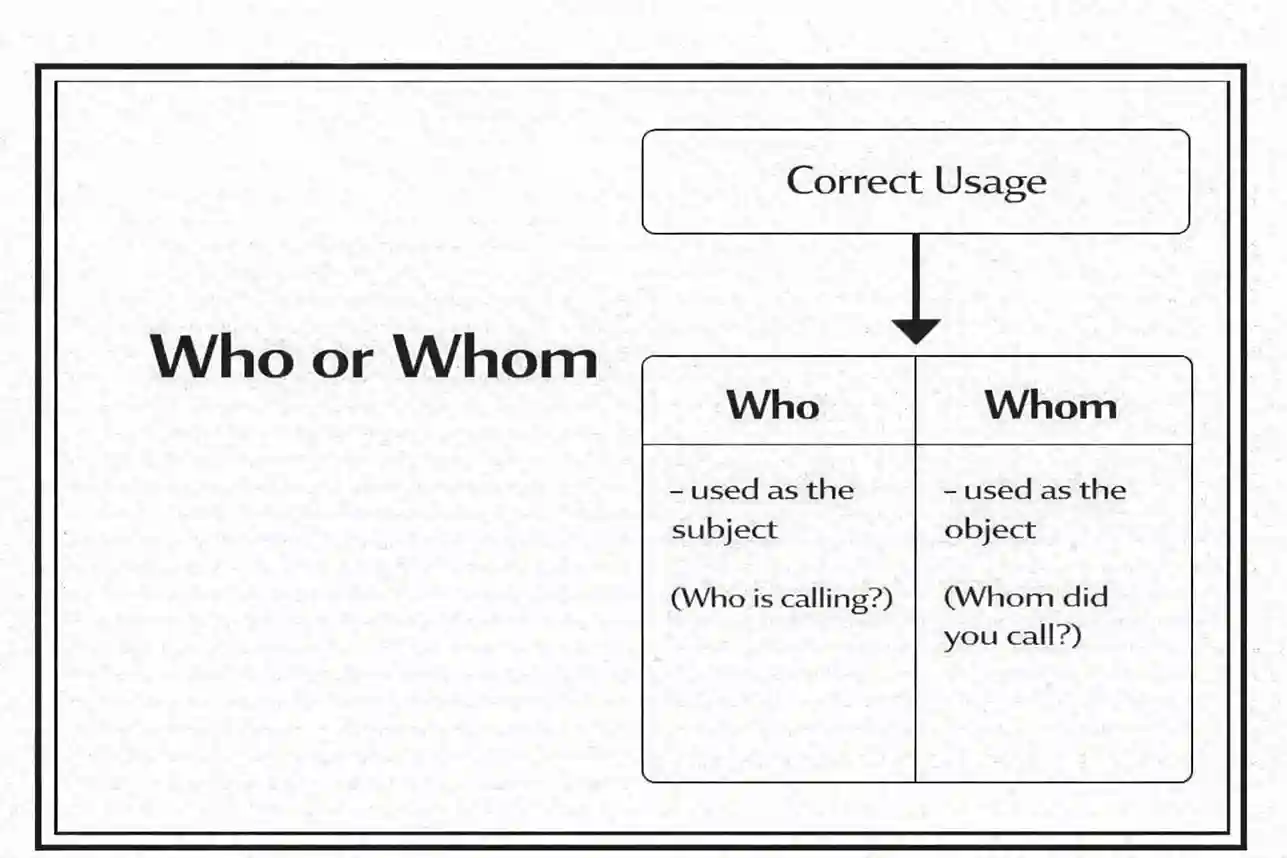
Who is used for the person doing the action in a sentence.
In grammar terms, “who” is the subject. But you don’t need that word to understand it. Just remember:
who = the doer
Examples with “who”
- Who called you?
→ He called me. (he = who → correct) - Who broke the glass?
→ She broke the glass. - Who is coming to the party?
→ They are coming to the party. - Who wants tea?
→ He / She / They want tea.
In all these examples, who is the one doing something: calling, breaking, coming, wanting.
So when you’re stuck on who or whom, ask:
“Is this the person doing the action?”
If yes → who.
What Does “Whom” Mean?
Whom is used for the person receiving the action.
In grammar words, “whom” is the object. Again, you don’t need to remember that word. Just think:
whom = the receiver
Someone does something to whom.
Examples with “whom”
- Whom did you call?
→ I called him. (him = whom) - Whom did she invite?
→ She invited them. - For whom is this gift?
→ This gift is for her.
Here, someone else is doing the action.
The whom person is just receiving the action: being called, being invited, getting the gift.
So for who or whom, ask:
“Is this the person the action is done to?”
If yes → whom (especially in formal writing).
Who vs Whom – Easy Comparison Table
Here is a simple table to help you choose who or whom quickly:
| Role in the sentence | Question word | Answer check | Example question | Answer |
|---|---|---|---|---|
| Doer of the action | who | he / she / they | Who called you? | He called me. |
| Receiver of action | whom | him / her / them | Whom did you call? | I called him. |
If you can replace it with he / she / they, use who.
If you can replace it with him / her / them, use whom.
This is the easiest way to solve who or whom questions.
The He/Him Trick (The Best Shortcut)
This is the most useful trick for who vs whom.
Use it every time you feel confused.
- Look at the part of the sentence with who/whom.
- Try to answer it with he or him (or she/her, they/them).
- If he / she / they fits → use who.
- If him / her / them fits → use whom.
Example 1
Sentence:
Who/Whom did you invite?
Try to answer:
- You invited him. ✅
- You invited he. ❌ (wrong)
We use him, so the correct word is whom.
✅ Whom did you invite?
Example 2
Sentence:
Who/Whom is coming to dinner?
Answer:
- He is coming to dinner. ✅
- Him is coming to dinner. ❌
We use he, so the correct word is who.
✅ Who is coming to dinner?
Example 3
Sentence:
You gave the book to who/whom?
Answer:
- You gave the book to him. ✅
- You gave the book to he. ❌
So we choose whom:
✅ You gave the book to whom?
✅ More natural: To whom did you give the book? (formal)
✅ Casual: Who did you give the book to? (common in speech)
Notice: In very formal English, people prefer whom.
In everyday speech, many native speakers use who even when whom is strictly correct.
Who or Whom in Questions
Questions are where who vs whom shows up the most.
When to use “who” in questions
Use who when you are asking about the doer:
- Who called you? → He called me.
- Who made this cake? → She made this cake.
- Who wants to join us? → They want to join.
- Who is at the door? → He / She is at the door.
All of these are about who is doing the action, so who is correct.
When to use “whom” in questions
Use whom when you are asking about the receiver of the action:
- Whom did you call? → I called him.
- Whom are you waiting for? → I am waiting for her.
- Whom did they choose for the job? → They chose him.
- Whom did the teacher praise? → The teacher praised them.
Again, use the he/him test:
- If the answer is him/her/them, then whom is the correct choice.
Who or Whom After a Preposition (To, For, With, From)
Prepositions are small words like to, for, with, from, about, of, at, by.
In formal English, after a preposition we usually use whom, not who.
Formal style
- To whom it may concern,
- For whom is this package?
- With whom did you travel?
- From whom did you get this information?
In each case, whom comes after a preposition (to, for, with, from).
Casual style (everyday speech)
In everyday conversation, most people say:
- Who is this package for?
- Who did you travel with?
- Who did you get this from?
This is very common and feels natural in spoken English, even though formal grammar would use whom.
So, for who vs whom after prepositions:
- Formal writing → prefer whom (especially in letters, job emails, official documents).
- Casual speech → who is okay and very common.
Who or Whom in Relative Clauses (The Person Who/Whom…)
Sometimes who or whom comes in the middle of a sentence, not at the start.
For example:
- The man who/whom I met yesterday…
- The woman who/whom called you…
These parts are called relative clauses, but don’t worry about the term. Just apply the same “doer/receiver” idea.
When to use “who” in the middle
Use who when it is the doer in that small part of the sentence.
- The woman who called me was kind.
→ She called me. (she = who) - The student who won the prize is my friend.
→ He/She won the prize. - The people who work here are friendly.
→ They work here.
Here, who is doing the action (called, won, work).
When to use “whom” in the middle
Use whom when it is the receiver in that part of the sentence.
- The man whom I met yesterday is a doctor.
→ I met him yesterday. - The friend whom she invited did not come.
→ She invited him/her. - The person whom they selected was very qualified.
→ They selected him/her.
Again, the he/him trick works:
- If you can say he / she / they → who
- If you can say him / her / them → whom
💡 Note: In real life, many native speakers say:
- The man who I met yesterday…
- The friend who she invited…
Even though whom is technically more formal and “correct,” who is very common and accepted in casual speech and even in much modern writing.
Modern English: Do People Still Use “Whom”?
This is an important part of who vs whom that many guides don’t tell you clearly.
- In very formal English (official letters, exams, legal writing), whom still matters.
- In normal daily English, especially in speaking, who is used almost everywhere.
So, should you stop using whom completely?
Not exactly. Here’s a good balance:
Where “whom” is still useful
- In formal letters and emails
- In job applications or cover letters (when you want to sound polished)
- In exams and grammar tests
- After prepositions in formal writing:
“To whom it may concern,”
“The person with whom I spoke…”
Where “who” is fine
- Everyday conversations
- Text messages, chats, social media
- Casual emails to friends or coworkers
- Many blogs and articles written in simple, friendly style
So in who vs whom:
- If you want to be safe and formal, learn to use whom correctly.
- If you just want to sound natural in speech, who will carry most of the load.
Common Mistakes with Who or Whom (and Fixes)
Here are some very common mistakes and how to fix them.
Mistake 1: Using “whom” everywhere to sound fancy
❌ Whom is coming to the meeting?
✅ Who is coming to the meeting?
Here, the person is doing the action (coming), so we need who.
Mistake 2: Using “who” when the person receives the action (in formal writing)
❌ Who did you invite to the wedding? (casual speech, acceptable)
✅ Whom did you invite to the wedding? (formal)
Answer test:
You invited him/her/them → whom is correct.
Mistake 3: Forgetting the preposition rule in formal style
❌ The person who I spoke to was very helpful. (okay in casual speech)
✅ The person whom I spoke to was very helpful.
✅ Even more formal: The person to whom I spoke was very helpful.
Again, answer test:
I spoke to him/her → whom.
Mistake 4: Confusing “who” and “whom” in official greetings
❌ To who it may concern,
✅ To whom it may concern,
This phrase is fixed and always written with whom.
Practice Sentences – Who or Whom?
Try choosing who or whom in these sentences. Then check the answers.
- ___ is your best friend?
- ___ did you see at the mall?
- To ___ did you send the email?
- The girl ___ won the race is my sister.
- The man ___ they hired left the company.
- ___ are you waiting for?
- ___ wants to join the trip?
- With ___ did you go to the concert?
Answers
- Who is your best friend?
→ He/She is your best friend → doer → who - Whom did you see at the mall?
→ You saw him/her → receiver → whom - To whom did you send the email?
→ You sent the email to him/her → whom
(Casual: Who did you send the email to?) - The girl who won the race is my sister.
→ She won the race → doer → who - The man whom they hired left the company.
→ They hired him → receiver → whom
(Casual: The man who they hired…) - Whom are you waiting for?
→ You are waiting for him/her → whom
(Casual: Who are you waiting for?) - Who wants to join the trip?
→ He/She/They want to join → doer → who - With whom did you go to the concert?
→ You went with him/her/them → whom
(Casual: Who did you go to the concert with?)
Who or Whom – Simple Step-by-Step Method
Whenever you see a who vs whom problem, follow this easy method:
- Find the verb (action word) near who/whom.
- Ask: “Is this word the one doing the action or receiving it?”
- Try replacing it with he / she / they or him / her / them.
- If he / she / they fits → write who.
- If him / her / them fits → write whom.
Example:
I don’t know who/whom to trust.
- Try:
- I trust him. ✅
- I trust he. ❌
“Him” works, so the correct word is:
✅ I don’t know whom to trust.
(Casual speech often: I don’t know who to trust.)
Final Summary – Who or Whom in Easy Words
Let’s close the who vs whom question in one clear list:
- Who = the doer of the action
- Think he / she / they
- Who called? → He called.
- Whom = the receiver of the action
- Think him / her / them
- Whom did you call? → You called him.
- In questions:
- Who is coming? (doer)
- Whom did you see? (receiver)
- After prepositions in formal writing:
- To whom, for whom, with whom, from whom…
- In modern English:
- Whom is used in formal style.
- Who is used almost everywhere in casual speech, even when whom is technically correct.
If your brain ever freezes on who or whom, just ask:
“Can I answer with he/she/they or him/her/them?”
- If he / she / they → who
- If him / her / them → whom
That’s it. You now understand who vs whom better than most native speakers.

About Grayson
Grayson is a professional English language teacher and the founder of WordEncyclo. With years of teaching experience, he specializes in vocabulary development, etymology, and word usage. His mission is to make English words and their meanings accessible to learners at all levels through clear, accurate, and well-researched content.